Top 5 Greatest QB–WR Duos in NFL History — No. 4
The Dallas Cowboys dominated the NFL during the 1990s, winning three Super Bowls in four seasons and establishing one of the greatest dynasties in league history. While Emmitt Smith was the centerpiece of the rushing attack and Dallas possessed an outstanding offensive line, the connection between Troy Aikman and Michael Irvin was equally important to the team’s championship success.
Aikman was an accurate, composed quarterback who excelled at reading defenses and delivering the football on time. Irvin was a physical, competitive wide receiver who consistently won contested catches and delivered in critical moments. Their contrasting personalities complemented each other perfectly, and together they formed one of the greatest passing combinations the NFL has ever seen.
The Numbers Behind Their Partnership
The statistical production between Aikman and Irvin was remarkable, especially considering the run-oriented offense Dallas operated. According to a 2014 NFL analysis, the duo connected for 580 completions and 8,844 receiving yards from 1991 onward, ranking third in yards and fourth in completions among the quarterback-receiver combinations examined.
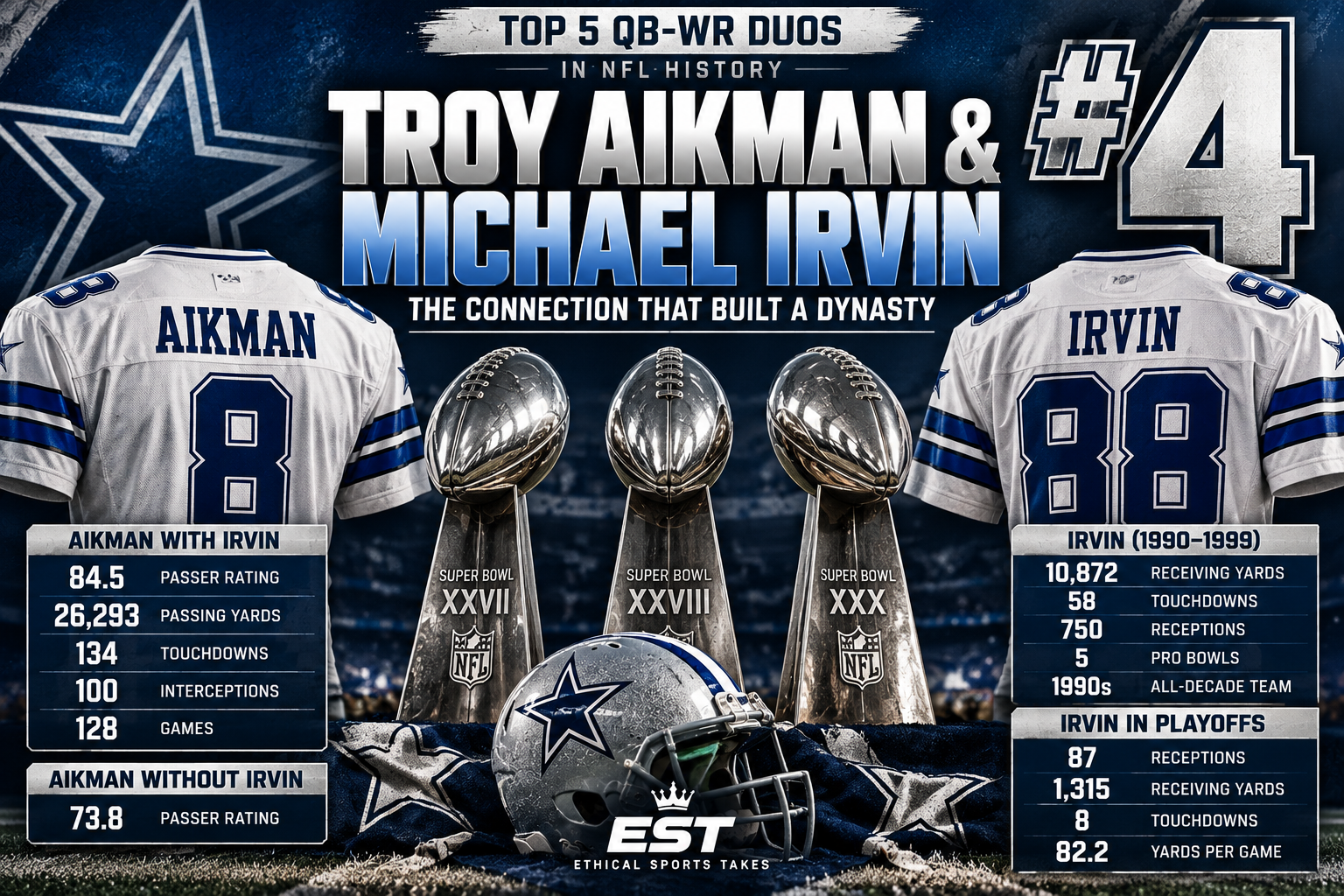
From 1990 through 1999, Irvin accumulated 10,872 receiving yards and 58 touchdowns, with the overwhelming majority of that production coming during his partnership with Aikman.
One statistic that highlights Michael Irvin’s importance to Troy Aikman is the quarterback’s performance when the two shared the field. Across 128 games alongside Irvin, Aikman threw for 26,293 yards, 134 touchdowns, and 100 interceptions, recording an 84.5 passer rating. In games without Irvin, that rating dropped to 73.8, a difference of 10.7 points. Although other factors contributed to that disparity, the numbers illustrate just how successful Aikman was with his favorite receiving target available. These figures represent Aikman’s overall passing performance in games with Irvin, rather than throws exclusively targeting him.
Their chemistry was especially evident during Irvin’s prime. From 1991 through 1995, he recorded five consecutive seasons with at least 1,200 receiving yards. His best statistical season came in 1995, when he caught 111 passes for 1,603 yards and 10 touchdowns, while Aikman threw for 3,304 yards and posted a 93.6 passer rating.
Irvin was not simply a deep threat. He was a reliable possession receiver who could make difficult catches over the middle, stretch the field, and consistently move the chains. His ability to create separation and win physical matchups made him Aikman’s most dangerous receiving weapon.
Three Super Bowls Together
What truly separates Aikman and Irvin from many other great quarterback-receiver combinations is their championship success. The Cowboys won Super Bowls XXVII, XXVIII, and XXX, defeating Buffalo twice and Pittsburgh once.
Aikman was particularly brilliant in Super Bowl XXVII, completing 22 of 30 passes for 273 yards, four touchdowns, and no interceptions. His 140.7 passer rating earned him Super Bowl MVP honors as Dallas demolished Buffalo 52–17.
The Cowboys repeated the following season, defeating the Bills 30–13 in Super Bowl XXVIII. Aikman completed 19 of 27 passes for 207 yards, while Irvin contributed to an offense that ultimately overwhelmed Buffalo.
Their third championship came in Super Bowl XXX against Pittsburgh. Aikman completed 15 of 23 passes for 207 yards and a touchdown, posting a 108.8 passer rating. Irvin caught five passes for 76 yards as Dallas secured a 27–17 victory.
Across those three Super Bowl victories, Aikman completed 56 of 80 passes for 687 yards, five touchdowns, and just one interception, producing a combined passer rating of approximately 111.9.
The Cowboys weren’t built exclusively around passing the football. Emmitt Smith was the centerpiece of their rushing attack, and Dallas possessed an outstanding offensive line. However, the threat of Aikman finding Irvin prevented defenses from focusing entirely on stopping the run.
That balance made the Cowboys extraordinarily difficult to defend.
Michael Irvin’s Playoff Dominance Alongside Troy Aikman
Michael Irvin’s postseason production further demonstrates just how dangerous his partnership with Troy Aikman was. Across 16 career playoff appearances, Irvin recorded 87 receptions, 1,315 receiving yards, and eight touchdowns, averaging 82.2 receiving yards per game. These are Irvin’s overall career playoff totals, including the 1991 playoff game that Aikman missed.
Irvin was particularly impressive during the Cowboys’ championship runs. In the 1992 postseason, he caught 18 passes for 288 yards and two touchdowns, including six receptions for 114 yards and two touchdowns in Dallas’ Super Bowl XXVII victory over Buffalo.
The following postseason, Irvin contributed another 16 receptions for 215 yards and a touchdown as the Cowboys secured their second consecutive championship.
His most productive postseason statistically came in 1994, despite Dallas falling short of the Super Bowl. Across just two games, Irvin recorded 18 receptions for 303 yards and two touchdowns. In the NFC Championship Game against San Francisco, he delivered an extraordinary performance with 12 receptions for 192 yards and two touchdowns, although the Cowboys ultimately lost 38–28.
Irvin continued delivering in the 1995 playoffs, recording 13 receptions for 185 yards and three touchdowns as Dallas captured its third Super Bowl in four seasons. His seven-catch, 100-yard, two-touchdown performance against Green Bay in the NFC Championship Game was particularly important.
These performances highlight what made the Aikman-Irvin connection special. Irvin wasn’t simply a receiver who benefited from playing on a dominant team. He consistently elevated his performances in the postseason, providing Aikman with a dependable target when the stakes were highest. Their chemistry was instrumental in turning an already talented Cowboys roster into a three-time Super Bowl champion.
Two Hall of Famers Who Elevated Each Other
Aikman finished his career with 32,942 passing yards, 165 touchdowns, six Pro Bowl selections, and three Super Bowl championships. He entered the Pro Football Hall of Fame in 2006.
Irvin retired with 750 receptions, 11,904 receiving yards, 65 touchdowns, and five Pro Bowl selections. He was inducted into the Hall of Fame in 2007 and earned recognition on the NFL’s 1990s All-Decade Team.
While both players possessed exceptional individual talent, their partnership elevated the Cowboys’ entire offense. Defenses could not simply commit additional defenders to stopping Emmitt Smith because Aikman and Irvin were capable of punishing single coverage.
Conversely, the presence of Smith forced opponents to respect the running game, creating opportunities for Aikman to attack through the air. It was a beautifully balanced offensive system, and the quarterback-receiver connection was an essential component.
Aikman and Irvin may not have the enormous passing totals of some modern quarterback-receiver combinations, but judging historical greatness exclusively through statistics ignores the differences between eras and offensive systems.
Their connection helped produce three Super Bowl championships, multiple dominant offensive seasons, and one of the most recognizable dynasties in NFL history.
Two Hall of Fame careers, three Lombardi Trophies, and years of outstanding production make Troy Aikman and Michael Irvin deserving of the No. 4 position on our list of the greatest quarterback-wide receiver duos in NFL history.
Next in the countdown: No. 3
Follow Ethical Sports Takes for the remainder of our Top 5 Greatest QB–WR Duos in NFL History series.
Leave a Reply