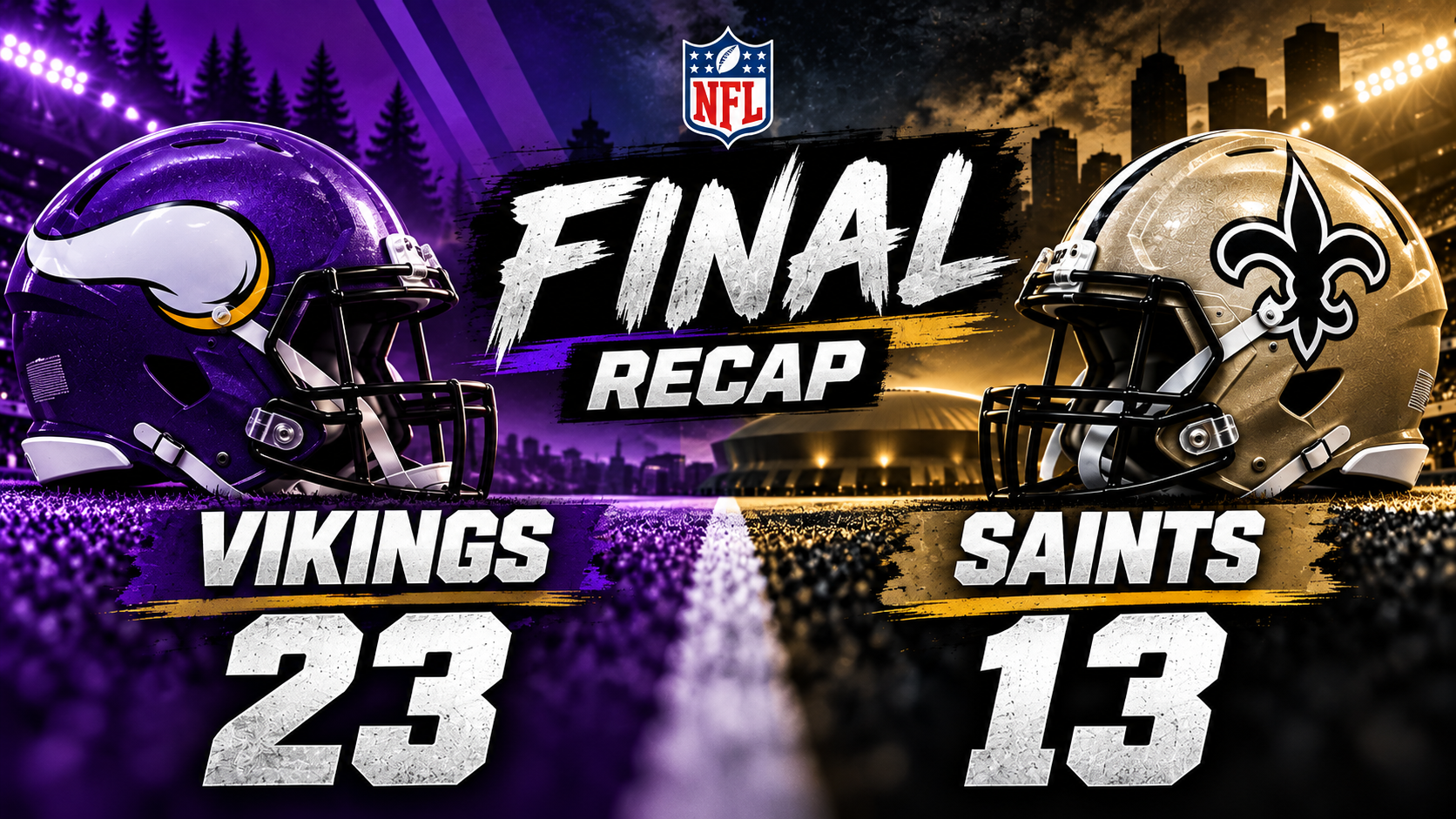
The Minnesota Vikings improved to 5–0 with a 23–13 victory over the New Orleans Saints at the Caesars Superdome on Sunday afternoon. It was far from a perfect performance, with both teams committing costly turnovers and penalties, but Minnesota’s defense ultimately proved to be the difference.
Kyler Murray delivered an efficient performance under center, Justin Jefferson produced another impressive showing, and Aaron Jones scored a crucial fourth-quarter touchdown. However, the biggest story was Brian Flores’ defense, which repeatedly frustrated Saints quarterback Tyler Shough and prevented New Orleans from establishing any consistent offensive rhythm.
For the Saints, it was another disappointing afternoon. Despite forcing turnovers and remaining competitive through three quarters, New Orleans struggled to capitalize on its opportunities.
First Quarter: Minnesota Strikes First in a Defensive Battle
The Vikings opened the contest looking to establish their passing attack, with Murray demonstrating excellent accuracy early.
Minnesota moved the football effectively at times, but New Orleans’ defense made things difficult whenever the Vikings approached scoring territory.
Will Reichard eventually opened the scoring with a 40-yard field goal, giving Minnesota a 3–0 advantage.
Neither offense managed to produce a touchdown in the opening quarter, setting the tone for what would become a physical, mistake-filled contest.
End of First Quarter: Vikings 3, Saints 0
Second Quarter: Saints Capitalize on a Costly Fumble
The second quarter featured one of the game’s most important early momentum swings.
Minnesota was threatening to extend its lead when Aaron Jones lost a fumble. Saints defensive tackle Khristian Boyd forced the football loose, and Chase Young recovered it, returning possession to New Orleans.
The Saints took advantage of the turnover by putting together an impressive 15-play, 66-yard drive. New Orleans converted two fourth downs during the possession before Kendre Miller powered into the end zone from two yards out.
The touchdown gave New Orleans a 7–3 lead.
Minnesota responded before halftime, with Murray continuing to find success through the air. He began the game by completing his first 12 passes, including an impressive 20-yard connection with Jefferson.
Despite the efficient passing performance, the Vikings struggled to finish drives with touchdowns.
Reichard connected on a 54-yard field goal as the first half expired, reducing New Orleans’ advantage to one point.
The Saints entered halftime ahead despite generating only 84 total yards and five first downs.
Halftime: Saints 7, Vikings 6
Third Quarter: Jefferson Scores Before a Defensive Touchdown Changes Everything
Minnesota finally found the end zone in the third quarter.
Murray connected with Jefferson for a spectacular 15-yard touchdown reception in the back of the end zone, giving the Vikings a 13–7 lead.
It was an important moment for Minnesota’s offense, which had struggled to turn promising possessions into touchdowns.
However, the Saints’ defense had another response.
With Minnesota facing third-and-15 near the New Orleans red zone, Murray completed a short pass to Myles Price. Saints cornerback Martin Emerson punched the football loose, allowing safety Jonas Sanker to recover it and race 87 yards for a defensive touchdown.
It was an extraordinary momentum swing that brought New Orleans back into the contest.
However, Daniel Carlson missed the extra point, leaving the game tied at 13.
The defensive touchdown highlighted just how much the Saints’ defense was carrying the team. New Orleans’ offense continued to struggle against Flores’ aggressive scheme, but the defense was doing everything possible to keep the game competitive.
End of Third Quarter: Vikings 13, Saints 13
Fourth Quarter: Jones Delivers as Flores’ Defense Takes Over
With the game tied entering the final quarter, Minnesota needed its offense to deliver.
Aaron Jones answered the call.
The veteran running back powered his way into the end zone for a crucial rushing touchdown, putting the Vikings ahead 20–13.
The score shifted the pressure firmly onto New Orleans, which had struggled to move the football throughout the afternoon.
Flores’ defense continued to make life miserable for Shough. Minnesota generated pressure, disrupted passing lanes, and repeatedly forced the Saints into difficult situations.
New Orleans eventually faced a crucial fourth down, but the Vikings’ defense held firm, forcing a turnover on downs.
Minnesota also had an unusual moment offensively when Jefferson attempted a pass on a trick play. The throw nearly resulted in an interception, but the Saints defender was unable to secure the football.
The Vikings ultimately added another field goal, extending their lead to 23–13 and making it a two-possession game.
New Orleans desperately needed a touchdown to remain competitive, but its final opportunity ended in another mistake.
Shough attempted a deep pass intended for Chris Olave, only for Minnesota to intercept it with less than two minutes remaining.
That turnover effectively sealed the result.
Minnesota had survived a difficult road contest, while New Orleans was left wondering how it had failed to capitalize on several promising opportunities.
Final Score: Minnesota Vikings 23, New Orleans Saints 13
Key Takeaways
1. Brian Flores’ Defense Is the Heart of Minnesota’s Success
Minnesota’s offense had its moments, but this victory belonged primarily to Brian Flores and his defense.
The Vikings consistently confused Shough with aggressive pressure packages, disguised coverages, and disciplined execution.
New Orleans struggled to establish any rhythm, particularly on third down, where Minnesota repeatedly forced difficult decisions.
The Saints also failed to respond after falling behind in the fourth quarter, with the Vikings securing a crucial fourth-down stop and a late interception.
Flores continues to demonstrate why he is one of the NFL’s most respected defensive coordinators.
2. Kyler Murray Was Efficient, but Minnesota Must Finish Drives Better
Murray opened the game with 12 consecutive completions, displaying excellent accuracy and confidence.
His connection with Jefferson was particularly effective, including the 15-yard touchdown that gave Minnesota its first offensive touchdown of the afternoon.
However, the Vikings settled for field goals too frequently and committed costly turnovers.
Against stronger opponents, Minnesota cannot rely entirely on its defense to overcome offensive mistakes.
Murray is demonstrating that he can operate this offense efficiently, but the Vikings must become more consistent in the red zone.
3. Justin Jefferson Continues to Make a Difference
Jefferson once again demonstrated why he is arguably the best wide receiver in football.
His touchdown reception in the third quarter was an outstanding display of body control and concentration, and his ability to create separation helped Murray sustain drives throughout the game.
Even when Minnesota’s offense struggled, Jefferson remained a reliable option.
The Vikings also experimented with using him as a passer on a trick play, although that nearly ended disastrously.
Jefferson’s receiving ability remains one of Minnesota’s greatest offensive advantages.
4. The Saints’ Offense Failed Its Biggest Test
New Orleans had opportunities to win this game.
Its defense forced multiple turnovers, produced a spectacular 87-yard fumble-return touchdown, and kept the contest tied entering the fourth quarter.
Unfortunately, the offense simply could not deliver.
Shough struggled to handle Minnesota’s defensive pressure and ultimately threw another costly interception while targeting Olave late in the game.
The Saints also committed penalties and struggled to convert important opportunities.
Credit belongs to Flores, but New Orleans must take responsibility for its lack of offensive execution.
5. Minnesota’s Conservative Play-Calling Remains a Concern
Despite the victory, Minnesota was occasionally too conservative offensively.
One particularly frustrating third-down decision involved a short screen pass when the Vikings had an opportunity to attack for a first down.
Settling for field goals can keep opponents in games, particularly when turnovers are already creating unnecessary problems.
Minnesota ultimately won by 10 points, but more aggressive and efficient execution could have put this contest away much earlier.
The Vikings have the offensive talent to do more than simply protect narrow leads.
Final Thoughts
The Minnesota Vikings remain undefeated, improving to 5–0 after another hard-fought victory.
This was not an offensive masterpiece. Both teams made costly mistakes, turnovers repeatedly shifted momentum, and neither side established consistent control until the fourth quarter.
However, Minnesota found a way to win.
Murray provided efficient quarterback play, Jefferson delivered another impressive performance, and Jones scored the touchdown that put the Vikings ahead for good.
Most importantly, Flores’ defense once again demonstrated its ability to take over a game.
For New Orleans, the loss was especially frustrating because the defense did enough to give the team a legitimate opportunity to win.
The Saints simply could not answer Minnesota’s defensive challenge.
The Vikings move forward undefeated, but their offensive consistency remains an area to improve as the season progresses.
For more NFL recaps, analysis, rankings, and weekly awards, follow Ethical Sports Takes.
Like, share, and subscribe for more independent sports coverage.
Leave a Reply