We continue our countdown of the five greatest championship runs in NBA history.
At number five, we had the 2017 Golden State Warriors and the Hampton Five, one of the most talented teams ever assembled.
At number four, we had Michael Jordan and the 1995–96 Chicago Bulls, who went 72–10 and dominated their way to another championship.
At number three, we had the 1994–95 Houston Rockets, who entered the playoffs as the sixth seed and defeated four teams with at least 57 wins on their way to back-to-back championships.
Now at number two, we have a championship run that wasn’t defined by an incredible regular-season record or complete domination throughout the playoffs.
It was defined by what happened at the very end.
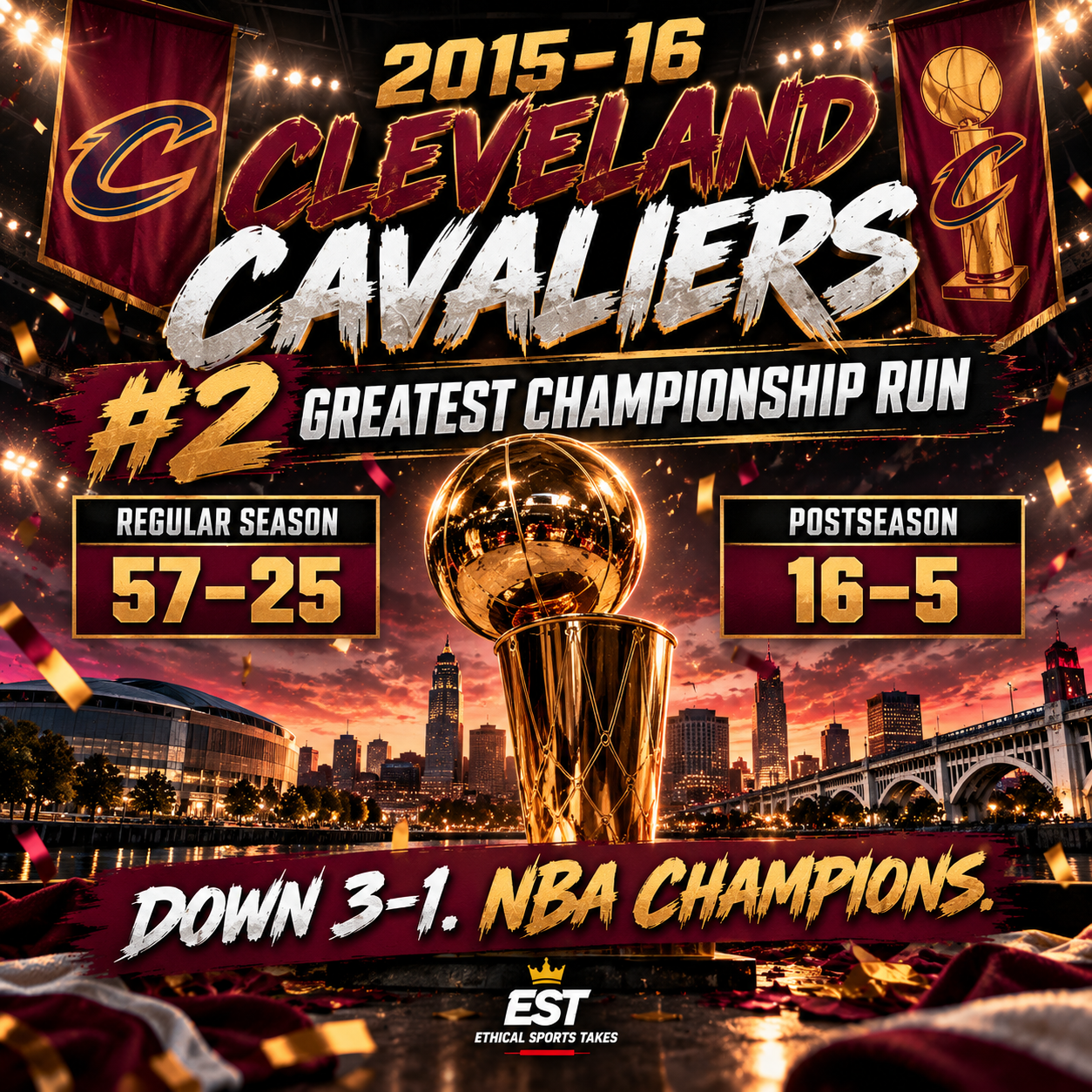
The 2015–16 Cleveland Cavaliers became the first team in NBA history to overcome a 3–1 deficit in the NBA Finals, and they did it against a Golden State Warriors team that had just won an NBA-record 73 games.
LeBron’s Second Year Back in Cleveland
LeBron James returned to Cleveland in 2014 with one goal: bring a championship to his hometown.
His first season back ended painfully.
Cleveland reached the 2015 NBA Finals, but injuries completely changed the series. Kevin Love missed the Finals after suffering a shoulder injury earlier in the playoffs, while Kyrie Irving fractured his kneecap in Game 1 against Golden State.
LeBron still managed to push the Warriors to six games, but Cleveland eventually lost the series 4–2.
That set the stage for 2016.
This time, Cleveland entered the postseason with LeBron, Kyrie and Love healthy and another opportunity to finish what they couldn’t the year before.
A 57-Win Regular Season
The Cavaliers finished the regular season 57–25, earning the number one seed in the Eastern Conference.
LeBron averaged 25.3 points, 7.4 rebounds and 6.8 assists per game, earning First Team All-NBA honors and finishing third in MVP voting.
Cleveland’s regular season wasn’t historically dominant.
It didn’t need to be.
The Cavaliers had established themselves as the best team in the Eastern Conference, and the real goal was getting back to the NBA Finals with their stars healthy.
Once the playoffs started, they wasted very little time.
First Round: Cavaliers Sweep the Pistons 4–0
Cleveland opened the postseason against the Detroit Pistons.
Detroit kept several of the games competitive, but the Cavaliers were simply too talented.
Cleveland swept the series 4–0, with Kyrie Irving leading the Cavaliers in scoring at 27.5 points per game.
One round down.
No losses.
Eastern Conference Semifinals: Cavaliers Sweep the Hawks 4–0
Next came the Atlanta Hawks.
Again, Cleveland didn’t lose a game.
The Cavaliers swept Atlanta 4–0, but this series also showed just how dangerous their offense could become.
Cleveland set an NBA record by making 25 three-pointers in Game 2, completely overwhelming Atlanta from behind the arc.
Through two rounds, Cleveland was 8–0.
The Cavaliers were halfway to another Finals appearance and still hadn’t lost a playoff game.
Eastern Conference Finals: Cavaliers Beat the Raptors 4–2
The Toronto Raptors finally gave Cleveland some resistance.
The Cavaliers dominated the first two games to take a 2–0 series lead, but Toronto responded by winning Games 3 and 4 at home to tie the series.
For the first time during the postseason, Cleveland had been challenged.
Their response was emphatic.
The Cavaliers destroyed Toronto 116–78 in Game 5 and then went on the road and won Game 6 113–87 to close out the series.
LeBron finished Game 6 with 33 points, 11 rebounds and six assists, sending Cleveland back to the NBA Finals.
The Cavaliers had gone 12–2 through the Eastern Conference.
Waiting for them was the team they had wanted another shot at all year.
NBA Finals: Cavaliers Beat the Warriors 4–3
The Golden State Warriors weren’t just the defending NBA champions.
They had just completed the greatest regular season in NBA history.
Golden State went 73–9, breaking the 72-win record set by the 1995–96 Chicago Bulls. Stephen Curry became the first unanimous MVP in NBA history, and the Warriors entered the Finals looking to complete one of the greatest seasons basketball had ever seen.
Cleveland wanted revenge for 2015.
At first, it looked like they weren’t going to get it.
Golden State won Game 1 104–89 and then destroyed Cleveland 110–77 in Game 2.
The Cavaliers responded with a 120–90 win in Game 3, but Golden State came right back and won Game 4 108–97.
The Warriors led the NBA Finals 3–1.
No team in NBA history had ever overcome a 3–1 deficit in the Finals.
Golden State needed one more victory.
Two of the final three potential games would be played at Oracle Arena.
Cleveland’s season looked finished.
Then everything changed.
Game 5: LeBron and Kyrie Make History
Facing elimination on the road, LeBron James and Kyrie Irving produced one of the greatest performances by a pair of teammates in Finals history.
LeBron: 41 points, 16 rebounds and seven assists.
Kyrie: 41 points and six assists.
They became the first teammates in NBA Finals history to each score at least 40 points in the same game.
Cleveland won 112–97.
The series was going back to Cleveland.
Game 6: LeBron Does It Again
LeBron followed one historic performance with another.
With Cleveland facing elimination again, he finished with 41 points, 11 assists and eight rebounds.
Back-to-back 41-point games.
Cleveland won 115–101.
A series that had been 3–1 was suddenly tied.
One game would decide everything.
Game 7: The Block, The Shot and The Stop
Game 7 at Oracle Arena became one of the most famous games in NBA history.
Neither team could pull away.
LeBron finished with 27 points, 11 rebounds and 11 assists, becoming only the third player in NBA history at the time to record a triple-double in Game 7 of the Finals.
But this game is remembered for three plays.
The Block.
With the score tied 89–89 and less than two minutes remaining, Andre Iguodala appeared to have a transition layup that would give Golden State the lead.
LeBron chased him down from behind and pinned the shot against the backboard.
One of the greatest defensive plays in NBA history.
Then came Kyrie Irving.
With 53 seconds remaining, Kyrie isolated Stephen Curry, created enough space and hit a three-pointer over him.
The Shot.
Cleveland led 92–89.
Golden State still had another opportunity, and Curry eventually got the matchup he wanted against Kevin Love.
Love stayed in front of him and forced Curry into a contested three-pointer.
Miss.
The Stop.
LeBron later split two free throws, Golden State couldn’t answer, and the clock finally hit zero.
Cavaliers 93. Warriors 89.
Cleveland was NBA champion.
3–1. 73–9. Cleveland Champions.
The final result is what makes this championship run historic.
57–25 in the regular season.
16–5 in the playoffs.
12–2 through the Eastern Conference.
Down 3–1 in the NBA Finals.
Three straight victories to win the championship.
And they did it against a Warriors team that had gone 73–9, the greatest regular-season record in NBA history.
LeBron averaged 29.7 points, 11.3 rebounds and 8.9 assists per game in the Finals and became the first player in NBA Finals history to lead both teams in points, rebounds, assists, steals and blocks for the series.
He was unanimously named Finals MVP.
More importantly, Cleveland’s victory ended the city’s 52-year major professional sports championship drought.
LeBron had returned home promising to bring a championship to Northeast Ohio.
Two years later, he delivered it in a way nobody had ever done before.
There have been more dominant championship teams.
There have been better regular seasons.
There have been easier playoff runs.
But no team had ever come back from 3–1 in the NBA Finals, and Cleveland did it against a 73-win defending champion.
That’s what defines this run.
The 2015–16 Cleveland Cavaliers are number two on my list of the greatest NBA championship runs of all time.
One remains.
Like the article and subscribe to Ethical Sports Takes for more NBA content.
Leave a Reply