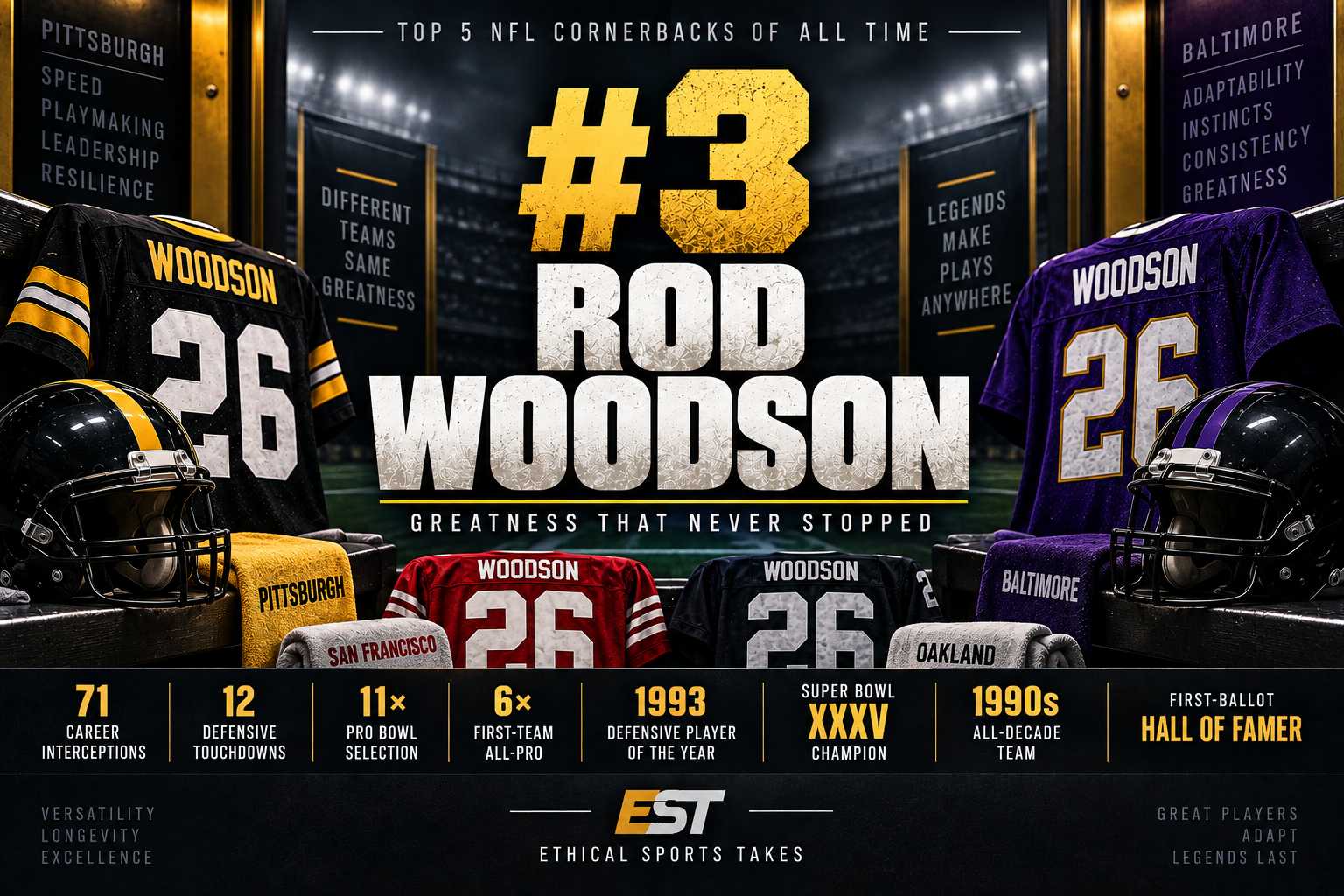
Most defensive backs would be fortunate to have one great chapter in the NFL. Rod Woodson had several.
He became one of the best cornerbacks in football with the Pittsburgh Steelers, won Defensive Player of the Year, came back from a devastating knee injury in remarkable fashion, reinvented himself as a safety later in his career, won a Super Bowl with one of the greatest defenses ever assembled and continued intercepting passes into his late 30s.
By the time his 17-year career was finished, Woodson had accumulated 71 interceptions, scored 12 defensive touchdowns and established himself as one of the most complete defensive backs the NFL has ever seen.
A Special Athlete Arrives in Pittsburgh
Before the NFL, Woodson was a phenomenal athlete at Purdue. He starred in football while also competing in track and field, and that athletic background was obvious once he reached the NFL. Woodson possessed the speed to run with receivers, the physicality to contribute against the run and the explosiveness to become dangerous whenever the football landed in his hands.
The Pittsburgh Steelers selected him 10th overall in the 1987 NFL Draft, beginning a relationship that would last a decade. Woodson quickly became much more than simply another starting cornerback. Pittsburgh also utilized his athleticism in the return game, giving him additional opportunities to affect games.
By 1989, he was a Pro Bowler. Soon, he would become one of the best defensive players in football.
The 1993 Defensive Player of the Year
Woodson’s peak in Pittsburgh produced one of the defining seasons of his career. In 1993, Woodson intercepted eight passes, returned one for a touchdown and established himself as the centerpiece of an excellent Steelers defense.
He could cover, tackle, create turnovers and turn those turnovers into points. Woodson had the athleticism expected from an elite cornerback, but his impact extended beyond simply preventing catches. At the end of the season, he received the NFL’s highest individual defensive honor: AP Defensive Player of the Year.
For a position where quarterbacks can sometimes minimize a player’s impact simply by throwing somewhere else, Woodson consistently found ways to influence games.
And then came one of the greatest comeback stories of his career.
The ACL Comeback
Pittsburgh entered the 1995 season with championship expectations, but Woodson’s season appeared to end almost immediately when he suffered a torn ACL during Week 1.
For almost any player, that meant the season was over. ACL reconstruction required a long rehabilitation process, and returning to an NFL field within the same season seemed nearly impossible. Woodson had other plans.
He underwent surgery and attacked his rehabilitation with the goal of returning if Pittsburgh reached the Super Bowl. The Steelers did exactly that.
Just months after tearing his ACL, Woodson returned to the field for Super Bowl XXX against the Dallas Cowboys, becoming the first player to return from reconstructive knee surgery during the same NFL season. Pittsburgh ultimately lost the game, but Woodson’s presence on the field was remarkable by itself.
An injury that should have ended his season didn’t stop him from reaching the biggest stage in football.
Leaving Pittsburgh
After the 1996 season, Woodson’s legendary run with Pittsburgh came to an end, but his career wasn’t close to finished.
He spent the 1997 season with the San Francisco 49ers before joining the Baltimore Ravens in 1998. By this stage of his career, Woodson was entering his 30s and eventually transitioning away from being primarily an outside cornerback.
For many defensive backs, this is where the decline begins. For Woodson, it opened another chapter.
His intelligence, instincts and ability to read quarterbacks translated beautifully to safety. He no longer needed to rely entirely on the athleticism that had made him such a dangerous cornerback earlier in his career. Instead, he began hunting the football from the middle of the field.
And the interceptions kept coming.
Reinventing Himself at Safety
Woodson’s move to safety demonstrated something that separates truly special defensive backs from everyone else: adaptability. He had already built a Hall of Fame-caliber résumé as a cornerback, but rather than fighting against the realities of aging, Woodson adjusted his game.
In 1999, at 34 years old, he intercepted seven passes for Baltimore and earned another Pro Bowl selection.
The following season, he became part of something historic.
Champion With One of the Greatest Defenses Ever
The 2000 Baltimore Ravens defense remains one of the most dominant units in NFL history. Ray Lewis controlled the middle, Baltimore’s defensive front overwhelmed opponents, the secondary punished mistakes, and Rod Woodson provided veteran intelligence and playmaking on the back end.
Baltimore allowed just 165 points during the regular season, setting an NFL record for a 16-game season at the time. The Ravens then tore through the postseason and reached Super Bowl XXXV against the New York Giants.
This time, unlike five years earlier with Pittsburgh, Woodson walked away from the Super Bowl as a champion. Baltimore destroyed New York 34–7, completing one of the greatest defensive seasons the league has ever seen.
After more than a decade of individual greatness, Woodson finally had his ring.
The Interceptions Never Stopped
Winning a championship didn’t signal the end. Woodson continued playing at a high level into his late 30s, and remarkably, some of his best ball production came during those final years.
In 2002, now playing for the Oakland Raiders at age 37, Woodson intercepted eight passes, leading the NFL. Fifteen years after entering the league as an explosive young cornerback, Woodson was still taking the football away more frequently than anyone else in the league.
He helped Oakland reach Super Bowl XXXVII, giving him his third Super Bowl appearance with three different franchises. By the time Woodson retired following the 2003 season, he had played 17 years and intercepted passes for Pittsburgh, San Francisco, Baltimore and Oakland.
71 Interceptions
Woodson finished his career with 71 interceptions, placing him among the most prolific ball hawks in NFL history. But simply counting the interceptions still doesn’t capture everything that made him special.
Woodson could turn turnovers into points. He finished with 12 interception-return touchdowns, an NFL record when he retired. Once the football was in his hands, his speed and return ability immediately turned him into an offensive threat.
That combination made challenging Woodson particularly dangerous. A bad throw wasn’t always going to result in a simple change of possession. Sometimes it resulted in six points going the other direction.
Seventeen Years of Greatness
Woodson’s career is remarkable because there wasn’t only one version of him. There was the explosive young Pittsburgh corner, the 1993 Defensive Player of the Year, the player who tore his ACL and somehow returned for the Super Bowl that same season, the veteran who reinvented himself at safety, the champion on Baltimore’s historic defense and the 37-year-old who still managed to lead the NFL in interceptions.
His final résumé speaks for itself:
Super Bowl XXXV Champion
1993 AP Defensive Player of the Year
11× Pro Bowl Selection
6× First-Team All-Pro
71 Career Interceptions
12 Interception-Return Touchdowns
NFL 1990s All-Decade Team
NFL 75th Anniversary All-Time Team
NFL 100th Anniversary All-Time Team
First-Ballot Pro Football Hall of Famer
Woodson was inducted into the Pro Football Hall of Fame in 2009, his first year of eligibility.
His career represents almost everything you could want from a defensive back: elite coverage ability, athleticism, physicality, turnovers, scoring ability, versatility, longevity, resilience and a championship. He became an elite NFL cornerback, and when age demanded that his game evolve, he became an elite safety.
Through all of it, Rod Woodson kept making plays.
Rod Woodson is #3 on the Ethical Sports Takes Top 5 Cornerbacks of All Time.
Next up: #2.
Leave a Reply