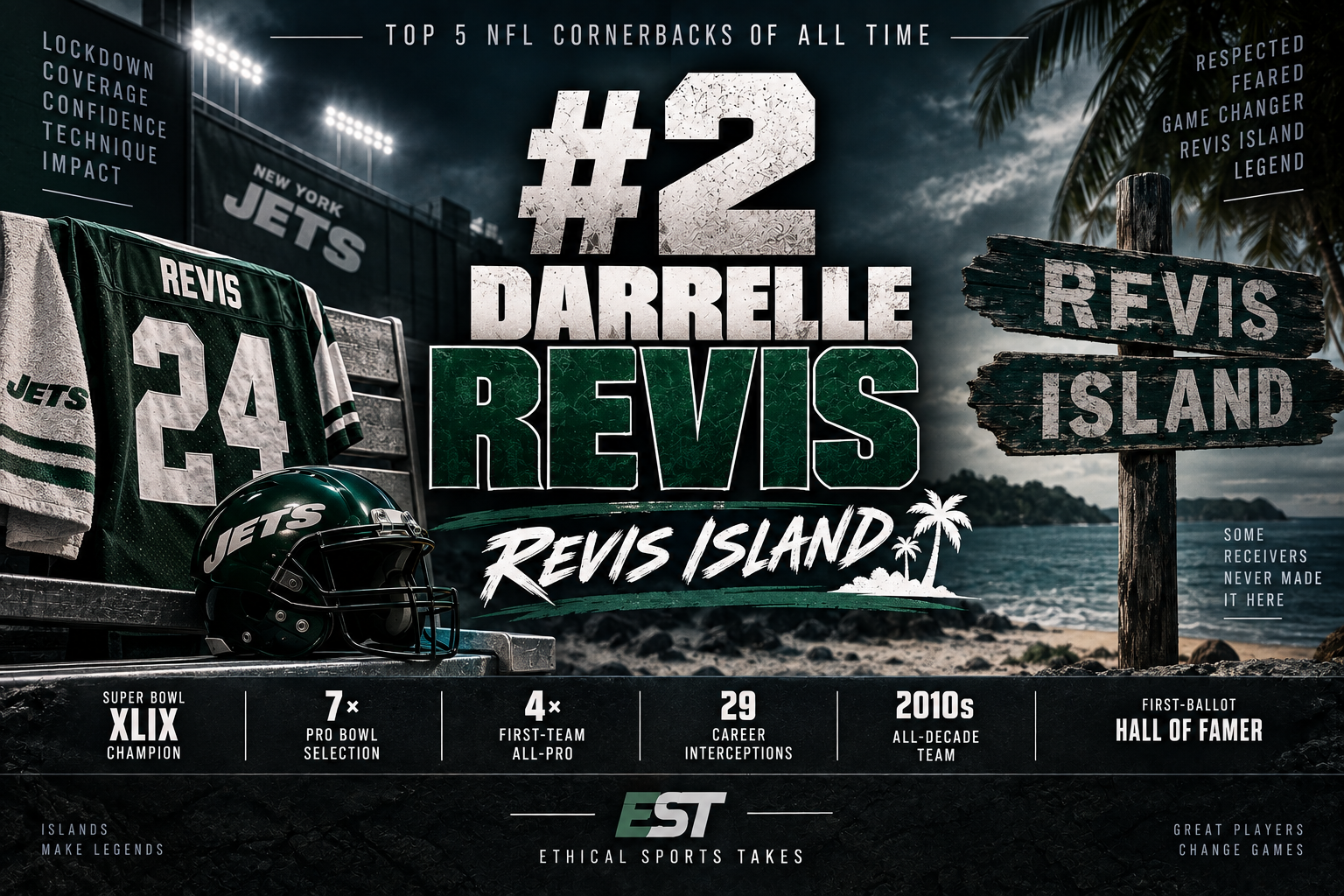
Some players need statistics to explain their greatness. Darrelle Revis had an island.
Revis Island became one of the most famous nicknames in NFL history because it perfectly described what happened to receivers when Revis lined up across from them. The New York Jets could put him on an opponent’s best receiver, trust him without constantly providing safety help and use the rest of their defense somewhere else.
For several years at his peak, there may not have been a more difficult cornerback in football to throw against. And at the absolute height of his powers, Revis produced one of the greatest seasons a cornerback has ever played.
Welcome to Revis Island
The New York Jets selected Revis 14th overall in the 2007 NFL Draft, and it didn’t take long for him to establish himself as an elite NFL corner. By his second season, Revis was a Pro Bowler. By his third, he had become the defining player of the Jets secondary and one of the most feared defensive backs in football.
What made Revis special wasn’t simply athleticism. His technique was extraordinary. He could play physical coverage at the line, mirror receivers through their routes and stay attached downfield without constantly grabbing or panicking when the football arrived.
Most importantly, the Jets trusted him. Revis wasn’t simply assigned to one side of the field and asked to cover whoever happened to line up there. He could follow an opponent’s top receiver and allow the rest of the defense to focus its attention elsewhere.
That’s where the nickname became reality. Send your WR1 over there.
Welcome to Revis Island.
The Legendary 2009 Season
If you want to understand why Revis ranks this high, start with 2009.
That season became the defining example of what true shutdown coverage could look like. Revis regularly matched up against some of the best receivers in football, and the list of names he encountered almost looks ridiculous in hindsight:
Andre Johnson. Randy Moss. Terrell Owens. Steve Smith. Roddy White. Chad Ochocinco. Reggie Wayne.
This wasn’t a cornerback spending the season hiding against secondary receiving options. Revis was being asked to deal with elite receivers week after week, and he kept winning.
He finished the regular season with six interceptions and 31 passes defended, earning First-Team All-Pro honors while becoming the centerpiece of the NFL’s top-ranked scoring and total defense. The Jets reached the AFC Championship Game, and Revis finished second in voting for AP Defensive Player of the Year.
But even those accomplishments don’t completely explain how dominant he was. You had to watch what offenses were doing around him.
When Not Throwing at You Becomes the Compliment
Cornerback statistics can be strange. A defensive back can finish with fewer interceptions simply because quarterbacks stop giving him opportunities to make them.
That’s important when discussing Revis. His greatness wasn’t built around gambling for interceptions or abandoning assignments to chase the football. His primary job was simpler to describe and much harder to accomplish: erase the receiver in front of him.
When Revis was at his best, quarterbacks had to decide whether challenging him was even worth the risk. Sometimes the smartest decision an offense could make was simply looking somewhere else.
That doesn’t appear in a traditional box score. There isn’t a statistic for we don’t want to throw over there. But anyone watching Revis Island understood exactly what was happening.
Built for Man Coverage
Revis was almost perfectly constructed for the type of football the Jets wanted to play under Rex Ryan. Ryan loved aggressive defense. He wanted to blitz, create pressure and force quarterbacks into uncomfortable situations.
Having Revis changed what was possible.
If the Jets could trust one cornerback to handle an elite receiver by himself, another defender could be used to rush the quarterback, disguise coverage or provide help somewhere else. Revis didn’t just win his individual matchup; his coverage ability gave the entire defense more freedom.
That is one of the biggest reasons his impact went beyond interceptions and passes defended. Every snap that Revis survived alone gave New York another option with the other ten defenders.
Dominance Beyond 2009
The legendary 2009 season wasn’t an isolated year. Revis earned another First-Team All-Pro selection in 2010, helping the Jets reach a second consecutive AFC Championship Game. He remained one of football’s premier corners in 2011 and earned First-Team All-Pro honors again.
Through that stretch, Revis Island had become part of NFL vocabulary.
Then came adversity. In 2012, Revis suffered a torn ACL, ending his season after just two games. The injury eventually marked the end of his first run with the Jets, and New York traded him to Tampa Bay before the 2013 season.
For a cornerback whose game depended heavily on movement, recovery and the ability to mirror elite athletes, a major knee injury could have permanently changed his career.
Revis still had more to accomplish.
One Year in New England, One Championship
After one season in Tampa Bay, Revis joined the New England Patriots in 2014. The uniform changed. The coverage didn’t.
Revis immediately returned to the top of the NFL, earning another Pro Bowl selection and his fourth First-Team All-Pro honor. More importantly, he finally reached the Super Bowl.
New England defeated the Seattle Seahawks 28–24 in Super Bowl XLIX, giving Revis the championship that had escaped him during those deep playoff runs with the Jets. After years of being one of the defining defensive players of his generation, Revis finally had a ring.
The Return to New York
Following his championship season in New England, Revis returned to the franchise where Revis Island had been created.
He rejoined the Jets in 2015 and immediately intercepted five passes, earning the seventh and final Pro Bowl selection of his career. The peak wouldn’t last forever, and Revis eventually finished his career with Kansas City in 2017, closing the book on an 11-season NFL career.
His final numbers don’t immediately jump off the page compared with some of the legendary ball hawks on this list. Revis finished with 29 interceptions. Rod Woodson had 71. Charles Woodson had 65. Champ Bailey had 52.
But judging Revis exclusively through interception totals completely misses what made him special.
The Greatest Statistic Was Avoidance
Revis isn’t #2 because he accumulated the most interceptions or because he played the longest. He’s here because at his peak, his ability to cover another human being was extraordinary.
There were seasons where the Jets could identify the opponent’s biggest receiving threat, assign Revis to him and construct much of the rest of their defensive strategy around the belief that Revis could survive that matchup. That’s an incredible level of trust to place in one cornerback, and Revis earned it.
His final résumé includes:
Super Bowl XLIX Champion
7× Pro Bowl Selection
4× First-Team All-Pro
29 Career Interceptions
NFL 2010s All-Decade Team
First-Ballot Pro Football Hall of Famer
Revis was inducted into the Pro Football Hall of Fame in 2023, his first year of eligibility.
But his greatest legacy may still be those two words: Revis Island.
Very few defensive players become so dominant at one specific responsibility that an entire concept becomes associated with their name. For years, the assignment was simple: take the opponent’s best receiver, follow him, cover him and make the quarterback find somebody else.
Darrelle Revis is #2 on the Ethical Sports Takes Top 5 Cornerbacks of All Time.
Only one man remains.
Next up: #1.
Leave a Reply