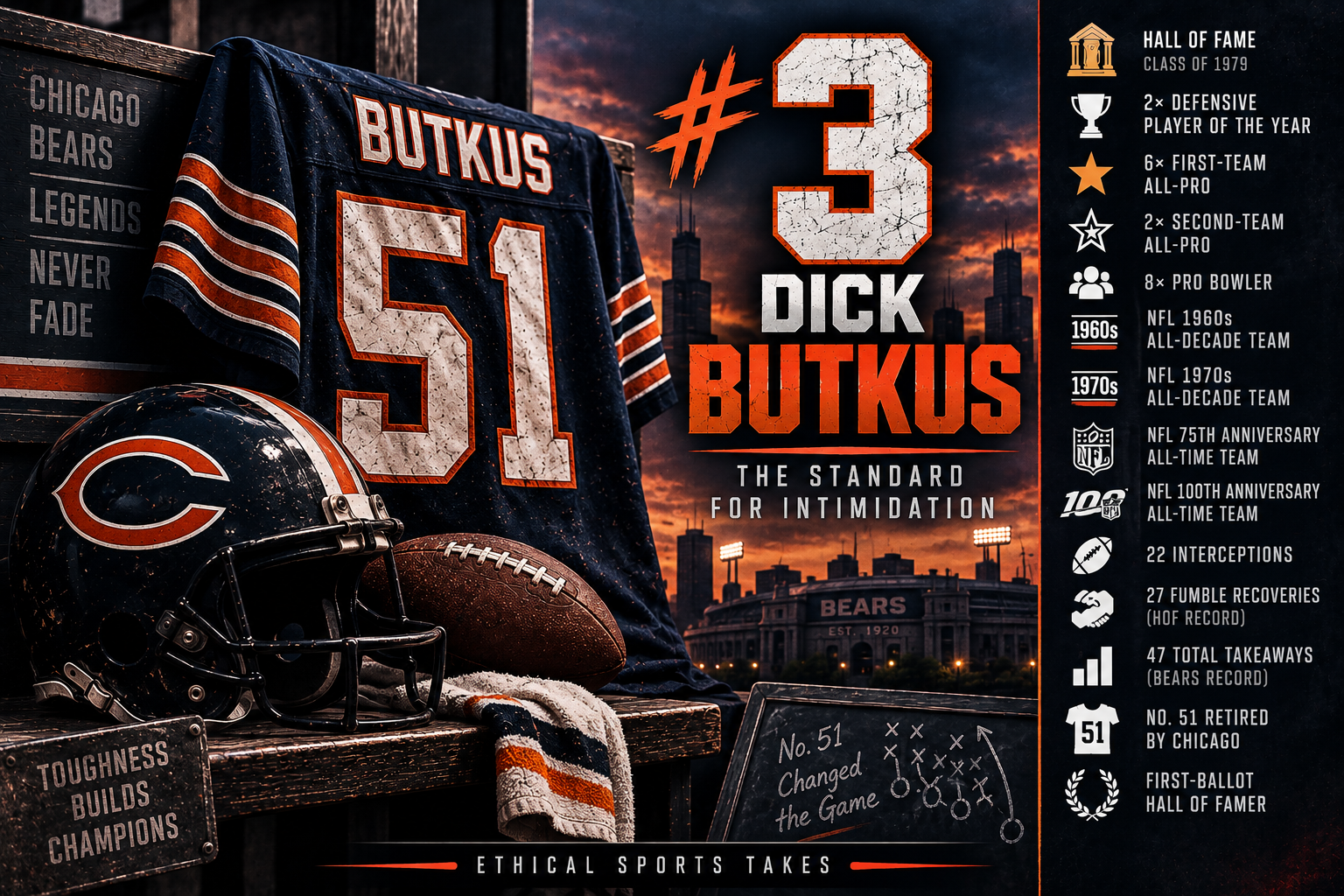
Before linebackers became sideline-to-sideline athletes, before defenses became obsessed with speed and versatility, there was Dick Butkus. For opposing offenses, simply knowing where No. 51 was lined up was part of the game plan.
There have been bigger linebackers. There have been faster linebackers. There have been players who lasted longer and accumulated greater career numbers. But very few defensive players in NFL history have ever created the combination of fear, respect and intimidation that followed Dick Butkus onto a football field.
But don’t mistake intimidation for a lack of skill. Butkus could run, cover, force turnovers and diagnose an offense with the best of them. The violence of his tackles became legendary, but underneath it was one of the most complete linebackers the sport had ever seen. At No. 3 on our list of the greatest linebackers in NFL history, we have Dick Butkus.
The Résumé
Butkus played only nine seasons, but his accomplishments established a standard that linebackers are still compared against more than half a century later.
Pro Football Hall of Fame, Class of 1979
2× NFL Defensive Player of the Year
6× First-Team All-Pro
2× Second-Team All-Pro
8× Pro Bowler
NFL 1960s All-Decade Team
NFL 1970s All-Decade Team
NFL 75th Anniversary All-Time Team
NFL 100th Anniversary All-Time Team
22 career interceptions
27 fumble recoveries according to Pro Football Hall of Fame records
47 total takeaways credited by the Chicago Bears
No. 51 retired by Chicago
First-ballot Hall of Famer
Butkus made the Pro Bowl in each of his first eight seasons and earned All-Pro recognition in seven of his nine years. He was also selected to two different All-Decade Teams despite playing only nine seasons. That’s dominance across an entire career.
Chicago Born, Chicago Made
There could hardly have been a more appropriate player to become the face of Chicago defense. Butkus was born and raised on the South Side of Chicago, became a star at Chicago Vocational High School and then stayed in Illinois to play college football for the University of Illinois.
The Bears selected their hometown linebacker with the third overall pick of the 1965 NFL Draft. Then, with the very next selection, Chicago drafted Gale Sayers. Two consecutive picks, two future first-ballot Hall of Famers and one of the most remarkable sequences in NFL Draft history.
Butkus didn’t need time to adjust to professional football either. As a rookie, he intercepted five passes and produced 12 takeaways while earning First-Team All-Pro honors. From the beginning, Chicago knew exactly what it had.
More Than Intimidation
Ask someone who never watched Dick Butkus play what they know about him, and the first answer will probably involve his physicality. That’s understandable. Butkus became synonymous with violent tackling, and his reputation became so enormous that stories about opposing players fearing him became part of NFL folklore.
But focusing only on the hits undersells the player. Butkus possessed excellent instincts and enough athleticism to cover enormous amounts of ground. The Pro Football Hall of Fame specifically notes his ability to make tackles from sideline to sideline while also covering tight ends and running backs in the passing game.
His 22 career interceptions are proof that he wasn’t simply standing in the middle waiting for someone to run the football. He could read quarterbacks, cover and take the football away. When an offense did decide to run toward him, they usually discovered why his reputation existed in the first place.
The Turnover Machine
One of the most overlooked parts of Butkus’ career was his ability to create and recover turnovers. The Chicago Bears credit him with 47 career takeaways, 22 interceptions and 25 fumble recoveries. The Pro Football Hall of Fame’s statistical record lists 27 opponent fumble recoveries, reflecting differences in historical recordkeeping from that era. Either way, the point remains the same. Butkus had an extraordinary ability to find the football.
His rookie season offered an immediate preview with five interceptions and seven fumble recoveries. That’s 12 takeaways from a rookie middle linebacker.
When Butkus retired, his career fumble recovery total stood as an NFL record. That part of his game sometimes gets lost behind the highlight reels of crushing tackles, but it shouldn’t. Butkus wasn’t simply trying to stop a play. He was trying to take the football away.
The Definition of a Middle Linebacker
There are certain players whose names eventually become associated with the position itself. For middle linebackers, Dick Butkus became one of those names.
He played with relentless aggression, but he also had the instincts and intelligence required to control the center of a defense. Running plays had to account for him. Passing concepts had to account for him. Ball carriers had to know where he was. He wasn’t merely participating in the defense. He dictated how offenses approached it.
The Pro Football Hall of Fame has described Butkus as the player who helped define the middle linebacker position, while generations of linebackers who followed him grew up watching his style of play. When people imagined the perfect old-school middle linebacker, tough, aggressive, intelligent and completely fearless, they imagined something very close to Dick Butkus.
Back-to-Back Defensive Player of the Year
By the end of the 1960s, Butkus had established himself as one of football’s premier defenders. He was named NFL Defensive Player of the Year in 1969 and again in 1970, giving him back-to-back awards during the heart of his prime.
The recognition is even more impressive when considering the era. Defensive football was filled with legendary players, and the middle linebacker position itself featured several eventual Hall of Famers. Yet Butkus became the standard.
His reputation wasn’t created decades later by nostalgic highlight packages. His contemporaries already viewed him as one of the most dominant defenders in football.
Greatness Without Team Success
There is one major accomplishment missing from Butkus’ résumé: postseason success. But that had little to do with him.
The Bears never reached the playoffs during his nine-year career. Chicago struggled for much of the era despite having one of the greatest defensive players in football patrolling the middle. In 1969, the Bears finished just 1-13. That same season, Butkus was named Defensive Player of the Year.
It’s one of the clearest illustrations of how dominant he was individually. Team success wasn’t creating his reputation. He was building it despite playing on teams that often weren’t competing for championships.
There was no Super Bowl run to elevate his legacy and no collection of postseason moments to strengthen his case. Dick Butkus became an icon almost entirely through the quality of his individual play.
The Knee That Ended It Early
Like Luke Kuechly at No. 5, Butkus is another example of a linebacker whose career could have been considerably longer. A serious right knee injury in 1970 began taking its toll. He continued playing through the damage, but his knee never fully recovered.
By 1973, his body had finally had enough. Butkus played only nine games that season before his career ended. He was just 30 years old.
His final numbers therefore don’t resemble those of linebackers who played 13, 15 or even 17 seasons, but his legacy was never about accumulating statistics. It was about what happened during those nine years.
A Legacy Bigger Than Nine Seasons
In 1979, Dick Butkus became eligible for the Pro Football Hall of Fame, and there wasn’t much suspense. He was inducted immediately in his first year of eligibility.
The Bears eventually retired his iconic No. 51, while the NFL selected him to both its 75th and 100th Anniversary All-Time Teams. His name also became permanently attached to the linebacker position through the Butkus Award, which recognizes elite linebackers at multiple levels of football.
Decades after his final NFL snap, young linebackers still knew the name. That is legacy.
The Standard
Dick Butkus played professional football for only nine seasons, but he helped shape the image of what a middle linebacker was supposed to be. He could run, cover, intercept passes, recover fumbles and control the middle of a defense.
And yes, he could hit.
Butkus made eight Pro Bowls in his first eight seasons, earned six First-Team All-Pro selections, won back-to-back Defensive Player of the Year awards and became a first-ballot Hall of Famer despite never appearing in a playoff game.
The sport has changed enormously since Dick Butkus played his final snap in 1973. The reputation hasn’t.
More than 50 years later, when football talks about intimidating middle linebackers, Dick Butkus is still the standard.
Do you agree with Dick Butkus at No. 3? Let us know in the comments.
Like the article and subscribe to Ethical Sports Takes for more rankings, stories and sports talk.
Leave a Reply