Imagine being an offensive lineman and knowing the man across from you weighed roughly 300 pounds, possessed overwhelming strength, and could still explode into the backfield before you had a chance to properly establish your block.
That was Reggie White.
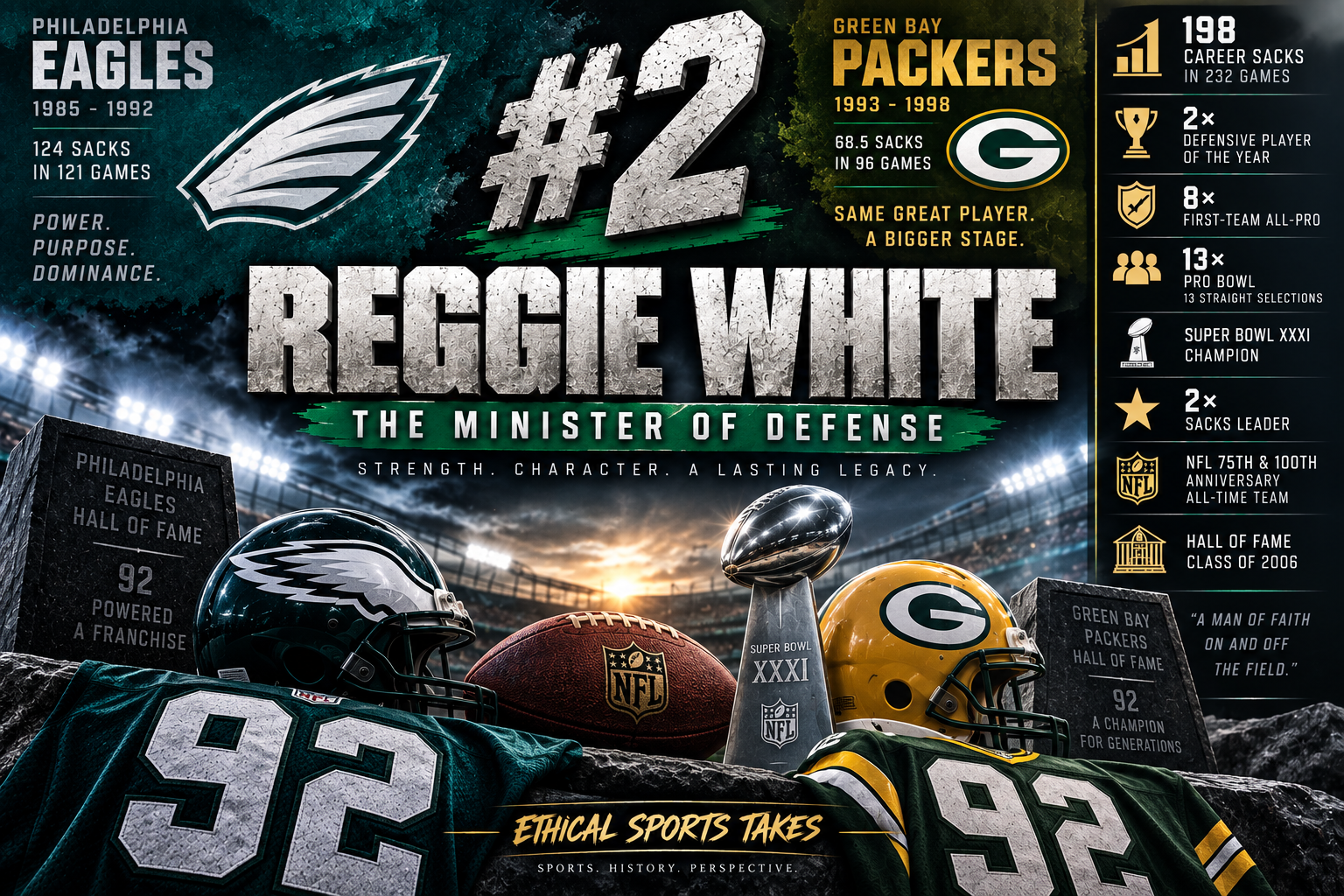
White didn’t need an elaborate collection of tricks to embarrass offensive linemen. His famous hump move allowed him to use his extraordinary power to toss blockers aside, often making NFL-sized offensive tackles look considerably smaller than they actually were. Then came the production: 198 official career sacks in just 232 regular-season games.
Only Bruce Smith finished with more official sacks, and he played 47 more regular-season games to get there. Reggie White combined power, technique, production and longevity into one of the most complete pass-rushing careers football has ever seen. They called him The Minister of Defense, and the nickname couldn’t have fit much better.
The Résumé
- Pro Football Hall of Fame — Class of 2006
- 198 official NFL career sacks
- 2× AP NFL Defensive Player of the Year
- 8× First-Team All-Pro
- 13× Pro Bowl
- 13 consecutive Pro Bowl selections
- 3× NFC Defensive Player of the Year
- 2× NFL sacks leader
- Super Bowl XXXI Champion
- NFL 1980s All-Decade Team
- NFL 1990s All-Decade Team
- NFL 75th Anniversary All-Time Team
- NFL 100th Anniversary All-Time Team
- Green Bay Packers Hall of Fame
- Philadelphia Eagles Hall of Fame
Before the NFL
White’s dominance didn’t begin when he reached Philadelphia. At the University of Tennessee, White established himself as one of the country’s premier defensive linemen and finished his college career as Tennessee’s all-time sacks leader at the time.
But his professional career began somewhere different. Instead of immediately joining the NFL, White signed with the Memphis Showboats of the United States Football League in 1984. He spent two seasons in the USFL and continued doing exactly what would eventually make him famous in the NFL: destroying quarterbacks.
When the USFL began collapsing, White finally made his way to the Philadelphia Eagles in 1985. The NFL was about to meet one of the greatest defensive players it had ever seen.
Philadelphia Gets Its Superstar
White didn’t require much time to adjust. Despite appearing in only 13 games during his first NFL season, he recorded 13 sacks. That was merely the beginning.
White followed with 18 sacks in 1986 and 11 in 1987 before producing one of the greatest pass-rushing seasons in NFL history. In 1987, NFL teams played only 15 regular-season games because of a players’ strike, and White himself appeared in just 12 games.
He recorded 21 sacks in those 12 games — 1.75 sacks per game.
White was named Defensive Player of the Year and established himself as one of the most terrifying defenders in football. It wasn’t a one-year explosion, either. During his eight seasons with Philadelphia, White recorded 124 sacks in 121 games.
More sacks than games played.
The Hump Move
Every legendary pass rusher has something opponents know is coming but struggle to stop anyway. For Reggie White, it was the hump move.
White would engage an offensive lineman and use his enormous upper-body strength to violently redirect the blocker sideways, clearing his path toward the quarterback. It looked almost unfair. NFL offensive linemen are enormous human beings specifically trained and paid to prevent defenders from reaching quarterbacks, yet White could make them look like they had been moved out of the way by a man several weight classes above them.
The move became synonymous with White because it perfectly represented his game. There was technique behind it. There was timing behind it. But most importantly, there was extraordinary power behind it.
Everyone knew it was coming. Stopping it was another matter.
Changing NFL Free Agency
Reggie White didn’t just alter games. He helped alter the business of professional football.
Following the 1992 season, White became the biggest name available under the NFL’s newly established system of unrestricted free agency. Teams across the league wanted him, but White ultimately chose the Green Bay Packers.
Today, Green Bay signing a superstar free agent doesn’t sound revolutionary. But at the time, White choosing the Packers carried enormous significance. Green Bay was a small-market franchise that had struggled through much of the previous two decades. The arrival of White demonstrated that elite free agents could choose Green Bay and that the Packers could compete for the biggest names on the open market.
The move helped change the perception of the franchise, and White didn’t arrive simply to collect a paycheck.
He kept dominating.
Dominance Followed Him to Green Bay
White was already 31 years old when he began his Packers career in 1993. That didn’t matter.
He recorded 13 sacks in his first season in Green Bay, followed by eight in 1994, 12 in 1995 and 8.5 in 1996. By then, the Packers had developed into one of football’s best teams behind Brett Favre on offense and White’s presence on defense.
Everything came together during the 1996 season. Green Bay reached Super Bowl XXXI against the New England Patriots with an opportunity to win the franchise’s first championship since Super Bowl II.
White made sure he left his mark.
He recorded three sacks in the Super Bowl, including two on consecutive plays late in the game, helping Green Bay secure a 35–21 victory. After years of individual dominance, The Minister of Defense finally had his championship.
Still Dominating at 37
By 1998, White had already accomplished virtually everything a defensive player could accomplish. He had the championship, a Defensive Player of the Year award, more than 170 career sacks and more than a decade of Pro Bowl selections.
And he was 37 years old.
Naturally, he went out and recorded 16 sacks.
That season earned White his second AP Defensive Player of the Year award, eleven years after winning his first. White had been recognized as the best defensive player in football in 1987, and more than a decade later he was recognized as the best defensive player in football again.
His 16 sacks in 1998 were also the highest total he had recorded since leaving Philadelphia. Father Time was arriving. Reggie apparently wasn’t interested.
Thirteen Straight Pro Bowls
Perhaps nothing demonstrates White’s sustained excellence better than this: from 1986 through 1998, Reggie White made the Pro Bowl every single season.
Thirteen consecutive selections.
Different quarterbacks, different offensive linemen, different teammates, different defensive systems and different franchises. The result remained the same: Reggie White was one of the best defensive players in football.
During that stretch, he also earned eight First-Team All-Pro selections and became one of the rare players recognized on two separate NFL All-Decade Teams, earning honors for both the 1980s and 1990s.
White wasn’t merely dominant during one era. His prime practically became an era of its own.
198
After briefly retiring following the 1998 season, White returned for one final year with the Carolina Panthers in 2000. He recorded 5.5 sacks at age 39, bringing his official NFL career total to 198.
Two short of Bruce Smith’s eventual record.
But context makes White’s number remarkable. Smith played 279 regular-season games to accumulate 200 sacks. White played 232 to accumulate 198.
That isn’t meant to diminish Smith’s extraordinary longevity. Reaching 200 sacks requires a level of sustained greatness almost nobody in football history has possessed. It simply illustrates how frequently White reached quarterbacks during the games he played.
And remember: those 198 sacks don’t include his professional seasons in the USFL before joining Philadelphia. From the moment White became a professional football player, quarterbacks were in trouble.
An All-Time Legacy
Reggie White’s place in football history was recognized long before his career ended. He was selected to the NFL’s 75th Anniversary All-Time Team in 1994 while he was still playing.
Years later, he was selected again when the league assembled its 100th Anniversary All-Time Team, placing White among the greatest defensive ends from the NFL’s first century.
His number 92 was retired by both the Philadelphia Eagles and Green Bay Packers, a remarkable distinction that demonstrates what he meant to two franchises.
Tragically, White died in 2004 at only 43 years old. Two years later, in his first year of eligibility, he was posthumously inducted into the Pro Football Hall of Fame.
His career had long since made the destination inevitable.
The Minister of Defense
Power alone doesn’t make someone one of the greatest pass rushers ever. Neither do sacks or longevity.
Reggie White had all of it.
He could overwhelm offensive tackles with brute strength, beat blockers with technique, destroy quarterbacks at a historic rate and maintain that dominance for more than a decade. He recorded 124 sacks in 121 games for Philadelphia, arrived in Green Bay after turning 30 and helped transform the Packers into champions, and at 37 years old recorded 16 sacks and won another Defensive Player of the Year award.
When his NFL career finally ended, his name sat beside 198 sacks.
The man one spot ahead of him on our list changed what an edge rusher could be, but before we get to #1, respect must be paid to one of the most powerful, productive and relentless defensive players ever to step onto an NFL field.
The Minister of Defense takes the #2 spot on our list.
If you enjoyed this article, leave a like and subscribe to Ethical Sports Takes so you don’t miss #1 as we reveal the greatest edge rusher in NFL history.
Leave a Reply