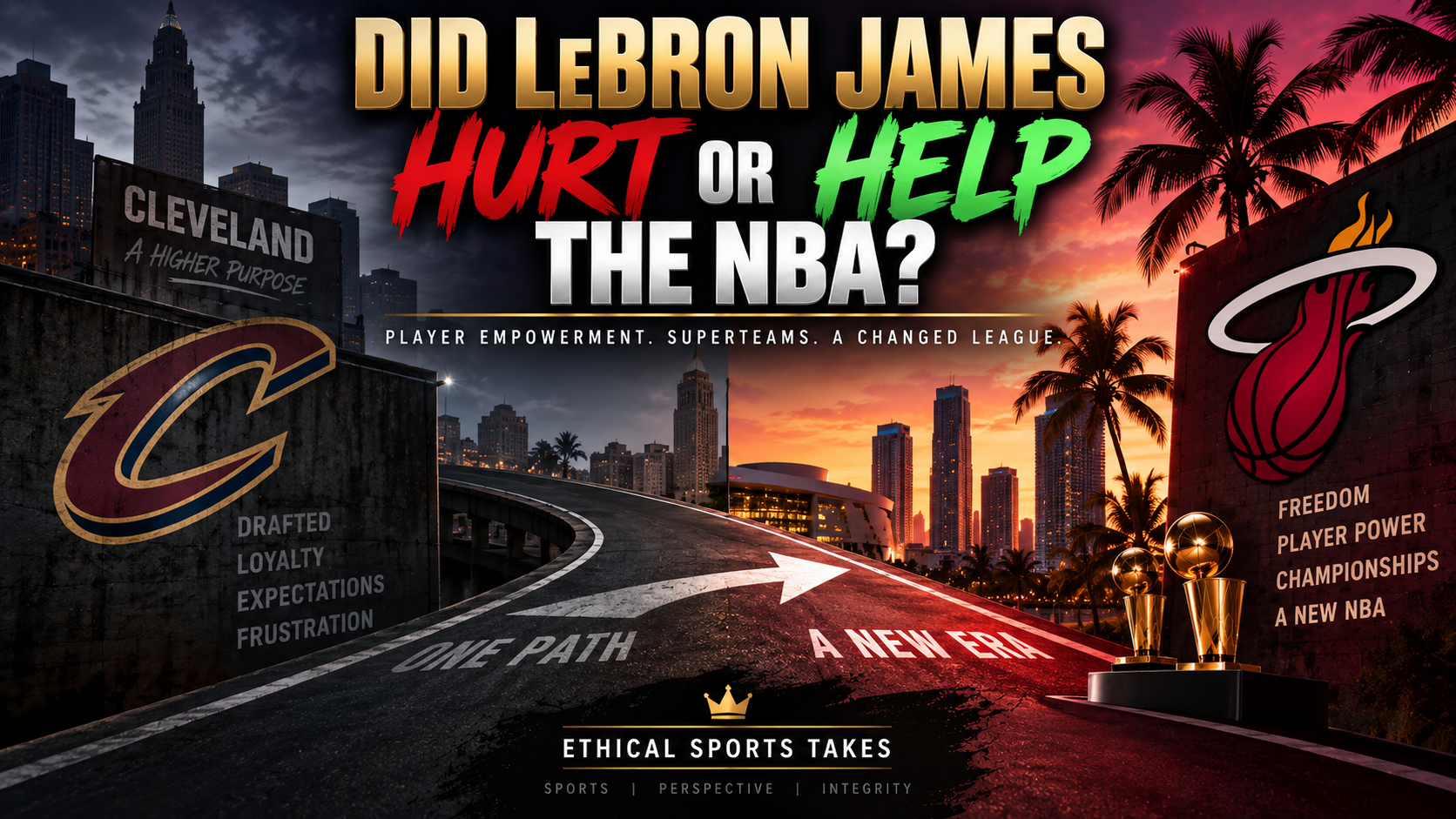
Before LeBron James decided to take his talents to South Beach during his infamous Decision, there was a much stronger expectation about how the career of an NBA superstar was supposed to work.
You got drafted by a franchise, and that franchise largely controlled what happened next. Maybe you spent the majority of your career there. Maybe the organization eventually traded you for younger players and draft picks. Free agency existed long before LeBron, of course, and plenty of stars changed teams, but the balance of power still heavily favored owners, general managers and organizations.
Then came 2010. LeBron had spent seven seasons in Cleveland. He had won two MVP awards and carried the Cavaliers all the way to the NBA Finals, but a championship never came. Instead of continuing to wait for Cleveland to build the championship team he wanted around him, LeBron decided to take control of his own career. On July 8, 2010, he announced that he was leaving Cleveland and joining Dwyane Wade and Chris Bosh with the Miami Heat.
The NBA had seen teams loaded with Hall of Fame talent long before Miami. What made this different was how much control the players themselves had in bringing it together. This wasn’t simply a general manager making trades and assembling a roster. The stars themselves played an active role in creating the situation they wanted.
That moment changed the NBA.
For decades, organizations had been allowed to trade players whenever they believed it benefited the franchise. A player could build a life in one city, raise his family there and represent the organization for years, only to wake up one morning and learn that he had been traded somewhere else because management believed it made basketball sense. Nobody considered that unusual. It was business.
LeBron effectively asked a different question: If organizations are allowed to make decisions based entirely on what’s best for them, why shouldn’t players do the same?
Taking Control of Your Own Career
LeBron went to Miami because he believed it gave him a better opportunity to accomplish his ultimate goal: winning a championship. And it worked.
The Heat reached the NBA Finals in all four of LeBron’s seasons in Miami and won consecutive championships in 2012 and 2013. LeBron won two MVPs and two Finals MVPs during those four years before eventually exercising his freedom again and returning to Cleveland in 2014.
But the bigger legacy of The Decision wasn’t simply those two championships. It was showing every superstar who came after him just how much power an elite player could have. If you’re one of the handful of people on Earth capable of completely changing the direction of an NBA franchise, why shouldn’t you use that leverage?
Players began becoming more comfortable requesting trades, communicating where they wanted to play and using impending free agency as leverage. A superstar could essentially tell an organization: You can trade me somewhere I want to go now and receive assets in return, or I can leave when my contract expires and you might receive nothing.
Suddenly, the conversation between stars and franchises wasn’t nearly as one-sided.
Then Kevin Durant Took It Even Further
Six years after The Decision, Kevin Durant became an unrestricted free agent. The Golden State Warriors had just won 73 games, the most ever in an NBA regular season, before losing a 3–1 Finals lead to LeBron and the Cavaliers. Durant’s Oklahoma City Thunder had also blown a 3–1 lead against those Warriors in the Western Conference Finals.
Then Durant joined Golden State.
He walked onto a roster that already included Stephen Curry, Klay Thompson and Draymond Green, creating one of the most talented teams basketball had ever seen. Golden State won championships in 2017 and 2018, with Durant winning Finals MVP both times.
Would Durant have made that exact decision without LeBron going to Miami six years earlier? Nobody can know. But LeBron had already demonstrated that a superstar didn’t have to accept whatever situation his original franchise gave him. A player could look around the league, decide where he believed his best opportunity existed and use free agency to create that situation himself.
Durant took that freedom and made his own decision.
But Did Player Empowerment Go Too Far?
This is where the argument against what LeBron helped start becomes much stronger. There is a difference between players having control over their careers and contracts beginning to feel meaningless.
When a superstar signs a long-term contract and then demands a trade shortly afterward, fans have a legitimate reason to be frustrated. Teams make enormous financial and roster decisions based on those commitments. Fans buy jerseys. Organizations trade draft picks and other players believing a superstar will be part of their future. Then suddenly that player can decide he wants out.
We have also reached situations where stars reportedly have preferred destinations, which can reduce a team’s leverage because other organizations know the player may not want to stay with them long term. That isn’t necessarily healthy for competitive balance.
Player empowerment can become player control if taken too far, and there has to be some meaning behind signing a contract. But none of that means giving players more power was inherently a mistake.
Why Should Only the Owners Have Control?
This is ultimately where I land on the debate: I think LeBron helped the NBA.
The players are the engine of the league. Nobody buys a ticket because they desperately want to watch an owner sit courtside. Children don’t hang posters of general managers on their bedroom walls. Millions of people aren’t buying jerseys with the team president’s name across the back.
They come to watch the players.
The players produce the entertainment. Their talent generates the television audiences, ticket sales, merchandise sales, sponsorship opportunities and worldwide attention that make the NBA what it is. So why shouldn’t the people creating that value have significant control over their own careers?
For decades, teams could treat players like assets. If trading you made the roster better, you were traded. It didn’t matter if you loved the city. It didn’t matter if your children were settled in school. It didn’t matter if you wanted to finish your career there.
It’s just business.
Fair enough. But then it has to be business when the player makes the decision too.
If a player fulfills his contractual obligations and reaches free agency, he has earned the right to choose where he works next. If he wants to take less money to play with another superstar, that’s his decision. If he wants to return home, chase a championship or simply play somewhere he believes he’ll be happier, why should we have a problem with that?
Teams make decisions based on their interests every single year. Players should be allowed to consider theirs.
LeBron Changed the Balance of Power
LeBron James didn’t invent free agency. He didn’t invent superteams. He didn’t invent players leaving organizations. What he did was demonstrate the enormous leverage that the very best basketball players actually possess.
When he left Cleveland for Miami, the basketball world exploded. He became one of the most disliked athletes in America almost overnight. Cleveland fans burned his jerseys, and Cavaliers owner Dan Gilbert publicly attacked the decision after losing the superstar who had defined his franchise.
But beneath all the anger was a simple reality: LeBron had earned the right to leave. His contract was finished. He was a free agent. And he chose where he wanted to work next.
That’s something ordinary people do every day. If another company offers you a better opportunity, better coworkers, a better chance of advancing your career or simply a situation you believe will make you happier, nobody expects you to remain at your old company forever because they hired you first.
NBA players should not be treated differently simply because millions of people watch them work.
So, Did LeBron Hurt or Help the NBA?
Player empowerment hasn’t been perfect. Trade demands can become excessive. Long-term contracts should mean something. Constant player movement can make it harder for fans to become attached to teams, and stacking superstar talent can sometimes damage competitive balance. Those are legitimate criticisms of the NBA that followed.
But I still believe the larger change was positive.
LeBron helped shift some of the power away from owners and organizations and toward the people whose talent actually makes the league valuable. He showed players that they didn’t simply have to accept whatever situation was handed to them. They could think about their careers, use the leverage they had earned and make decisions based on what they believed was best for themselves.
Organizations still have enormous power. They can trade players. They can decline options. They can decide not to offer another contract. They can rebuild and move on whenever they believe it’s best for the franchise.
Players deserve some power too.
LeBron’s move to Miami might have created consequences that even he couldn’t have predicted. It helped normalize stars taking greater control over where and with whom they played, and the NBA is still dealing with both the benefits and drawbacks of that shift today.
But if you’re asking me whether putting more power into the hands of the people who actually make the product valuable was ultimately good for basketball?
Yes. You are the engine of the league. Make your value felt.
If you enjoyed this article, leave a like and subscribe to Ethical Sports Takes for more NBA discussion, Random Sports Talk and original analysis.
Leave a Reply