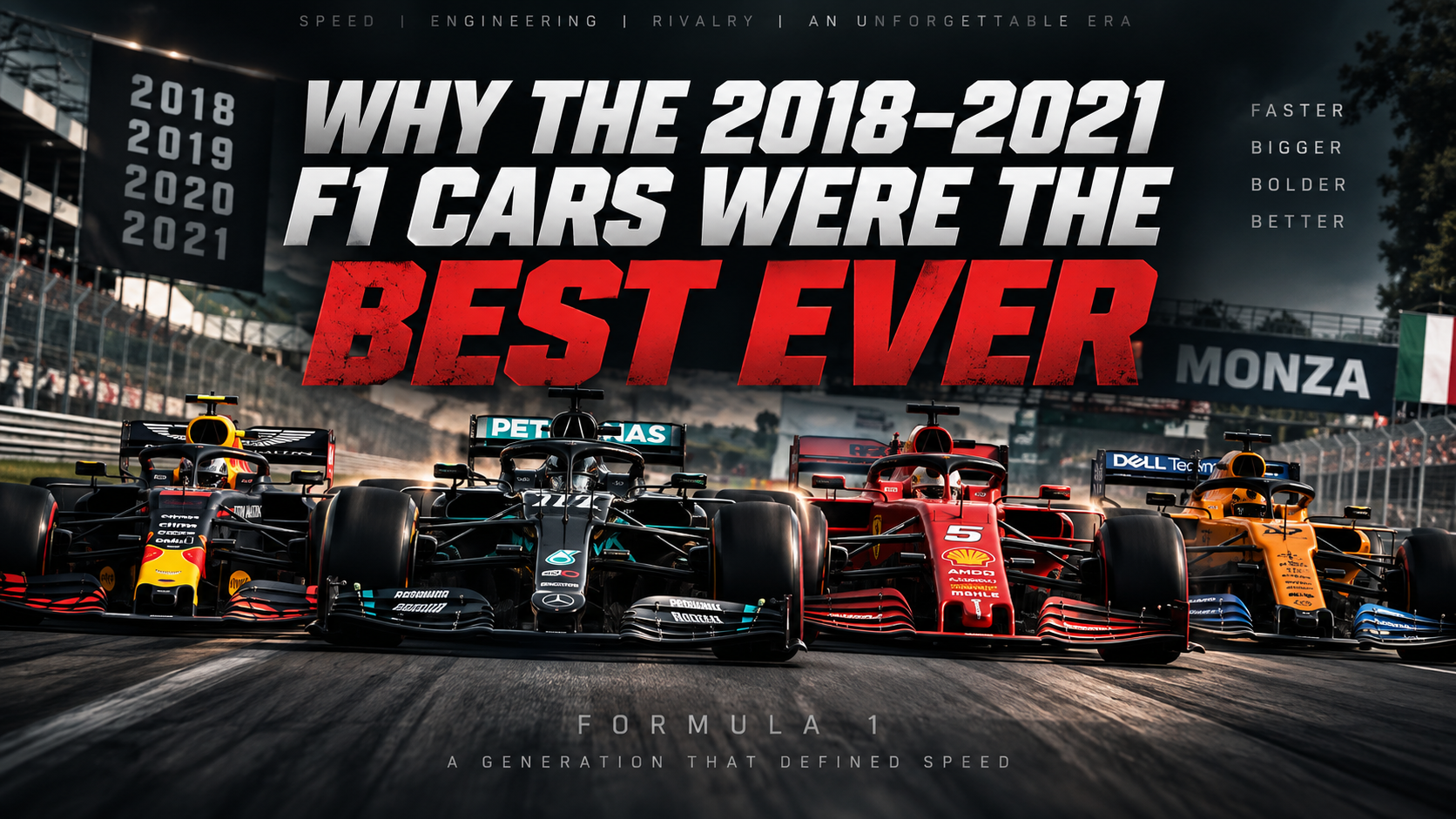
The 2018–2021 cars will always be my favorite cars in Formula 1 history. Yes, they did not have the massive engines or incredible sound of some previous generations, but what they lacked in noise they made up for by producing, in my opinion, the coolest-looking and fastest generation of F1 cars we have ever seen.
These cars looked like spaceships on wheels. They were wide, low, aggressive and covered in enormous aerodynamic surfaces. But their appearance was only half of what made them special.
The way they could attack corners was ridiculous.
The Fastest F1 Cars Ever
If there is one thing that separates this era from every other generation, it is the raw performance.
The ultimate example came at Monza in 2020. Lewis Hamilton put the Mercedes W11 on pole with a 1:18.887, averaging 264.362 km/h (164.267 mph) around the lap. At the time, it was the fastest average-speed lap in Formula 1 history.
And Monza was not the only place where this generation demonstrated its speed. Cars from this period produced extraordinary lap times across circuits such as Silverstone, Suzuka, Spa, Barcelona and others.
But numbers alone do not properly explain what watching these cars felt like.
You had to see them through the corners.
Qualifying Was a Gauntlet
This is probably what I miss most.
Qualifying in this era felt like a gauntlet.
Watching these cars on low fuel, fresh soft tires and maximum performance was one of the greatest spectacles Formula 1 could offer. Drivers would throw these enormous machines into high-speed corners at speeds that looked completely unreasonable.
Silverstone was incredible. Spa was incredible. Suzuka was incredible.
Corners that should have forced a driver to hesitate became demonstrations of commitment. The aerodynamic grip was so enormous that the faster the car traveled, the more alive it seemed to become.
There was something almost violent about these qualifying laps. The rapid direction changes, the speed through sweeping corners and the confidence drivers needed to extract everything from the car made Saturday almost as exciting as Sunday.
Sometimes you would watch an onboard qualifying lap and genuinely wonder how the car had managed to stay on the track.
That was the beauty of them.
The Cars Looked Incredible
Speed matters, but let’s be honest.
They also looked cool as hell.
The wider cars introduced in 2017 had matured aerodynamically by this period. Huge front wings, enormous rear tires, long wheelbases and intricate bodywork gave the cars an incredibly aggressive appearance.
Mercedes looked like it had built a machine in a laboratory specifically to destroy lap records.
Ferrari’s red cars looked fantastic, particularly when Sebastian Vettel was genuinely challenging Mercedes for championships.
Red Bull maintained one of the most recognizable designs on the grid, and the aggressive aerodynamic philosophy of its cars fit this generation perfectly.
McLaren’s return to papaya gave us another car that immediately stood out.
Every team had its own identity, but the entire grid looked purposeful. These were not small, delicate-looking race cars.
They looked like monsters.
The W11 Was the Peak of Pure Speed
If there is one machine that represents the outright performance potential of this generation, it has to be the Mercedes W11.
The 2020 Mercedes might be the greatest Formula 1 car ever built.
Lewis Hamilton and Valtteri Bottas routinely produced qualifying performances that seemed almost unfair. Mercedes had already dominated much of the hybrid era, but the W11 felt like the final form of everything the team had learned since 2014.
The car had power, aerodynamic efficiency, incredible cornering ability and innovations such as the DAS system. It was engineering pushed to an absurd level.
Hamilton won the championship comfortably and equaled Michael Schumacher’s seven World Championships that season.
But the W11 was not the only great machine this generation produced.
Far from it.
Red Bull Built a Monster Too
By the end of this generation, Red Bull had built a beast of its own.
Years of development around Max Verstappen finally culminated in the RB16B for 2021, a car genuinely capable of taking the fight to Mercedes across an entire season. This was no longer Red Bull stealing victories when circumstances fell its way. They had built a championship-caliber machine.
The RB16B was quick almost everywhere. Verstappen could attack high-speed corners with incredible confidence, and the combination of Red Bull’s aerodynamic philosophy, Honda’s improved power unit and Max’s relentless driving created the first true season-long threat to Mercedes’ dominance in years.
And that is part of what made this generation so special.
It did not end with Mercedes cruising into the sunset.
It ended with another team finally building a monster capable of challenging them.
Mercedes responded with an increasingly rapid W12, Red Bull had the RB16B, and Hamilton and Verstappen spent 2021 pushing both cars to their absolute limits. By the closing races, the performance battle had become incredible to watch.
These regulations had started with Ferrari and Mercedes fighting near the front in 2018 and ultimately ended with Red Bull and Mercedes producing two championship-worthy machines and two generational drivers fighting until the final race.
That is one hell of a way for an era of Formula 1 cars to go out.
Ferrari Had Its Moments Too
It is also easy to forget just how competitive Ferrari was at the beginning of this period.
The 2018 Ferrari gave Sebastian Vettel a legitimate opportunity to fight Hamilton for the World Championship. For significant portions of that season, Mercedes could not simply arrive at a circuit expecting to dominate.
Then Charles Leclerc arrived at Ferrari in 2019 and immediately began showing why he was considered one of Formula 1’s brightest young talents.
Ferrari’s championship hopes ultimately disappeared, but those cars still contributed to what made the period memorable. We had Mercedes at the height of its dynasty, Ferrari desperately trying to break it and Red Bull gradually building toward the machine that would finally challenge it.
There was a progression to the entire era.
The Perfect Ending: 2021
If this generation of Formula 1 cars needed a final chapter, it could hardly have received a better one.
Lewis Hamilton versus Max Verstappen.
Mercedes versus Red Bull.
The established king against the driver trying to take his crown.
The championship battle traveled around the world and somehow reached Abu Dhabi with Hamilton and Verstappen tied on points.
Whatever your opinion of how that championship ended, the season itself was extraordinary.
And there was something fitting about these cars going out that way.
After years of Mercedes domination, Ferrari challenges, Verstappen’s rise and countless incredible qualifying laps, the final season of this generation gave us a championship fight that went down to the final lap of the final race.
Then Formula 1 changed.
The Ground-Effect Era
Formula 1 introduced dramatically different regulations for 2022, bringing back ground-effect aerodynamics with the goal of allowing cars to follow each other more closely.
There have been great races and great cars since then. The newer regulations have produced their own memorable moments, and Formula 1 will continue evolving because that is what the sport has always done.
But aesthetically and in terms of pure qualifying spectacle, I still prefer what came before.
The 2018–2021 machines felt more aggressive to me. Watching them attack high-speed corners was different. Watching a driver begin a qualifying lap knowing you were about to see one of the fastest racing machines humanity had ever created pushed to its absolute limit was special.
That feeling is difficult to replace.
An Era I Will Always Miss
Every Formula 1 fan has an era that feels like their era.
For some, it is Senna and Prost.
For others, it is Schumacher and Ferrari.
Some will always prefer the screaming V10s.
Others will remember Verstappen and Red Bull.
For me, when I picture the ultimate Formula 1 car, I picture the machines from 2018 through 2021.
They may not have sounded the best.
They may not have produced the closest racing every weekend.
But they were brutally fast, visually stunning and capable of attacking corners in a way that sometimes barely looked possible.
The W11 showed us just how fast an F1 car could become. Ferrari gave Mercedes a legitimate fight early in the era. Red Bull spent years building toward the RB16B and finally produced a machine capable of taking Mercedes all the way to the final race.
At their absolute limit, these cars represented everything I love about Formula 1: engineering, bravery, precision and speed pushed to the extreme.
And whenever I go back and watch one of those qualifying laps, I still think the same thing:
Formula 1 has never looked faster.
Thanks for Reading
If you enjoyed this article, make sure to like the post and subscribe to Ethical Sports Takes for more Formula 1 stories, debates, rankings and analysis.
The 2018–2021 cars may be gone, but this era of Formula 1 will always be special to me.
Thanks for reading, and welcome to Ethical Sports Takes. 🏁
Leave a Reply