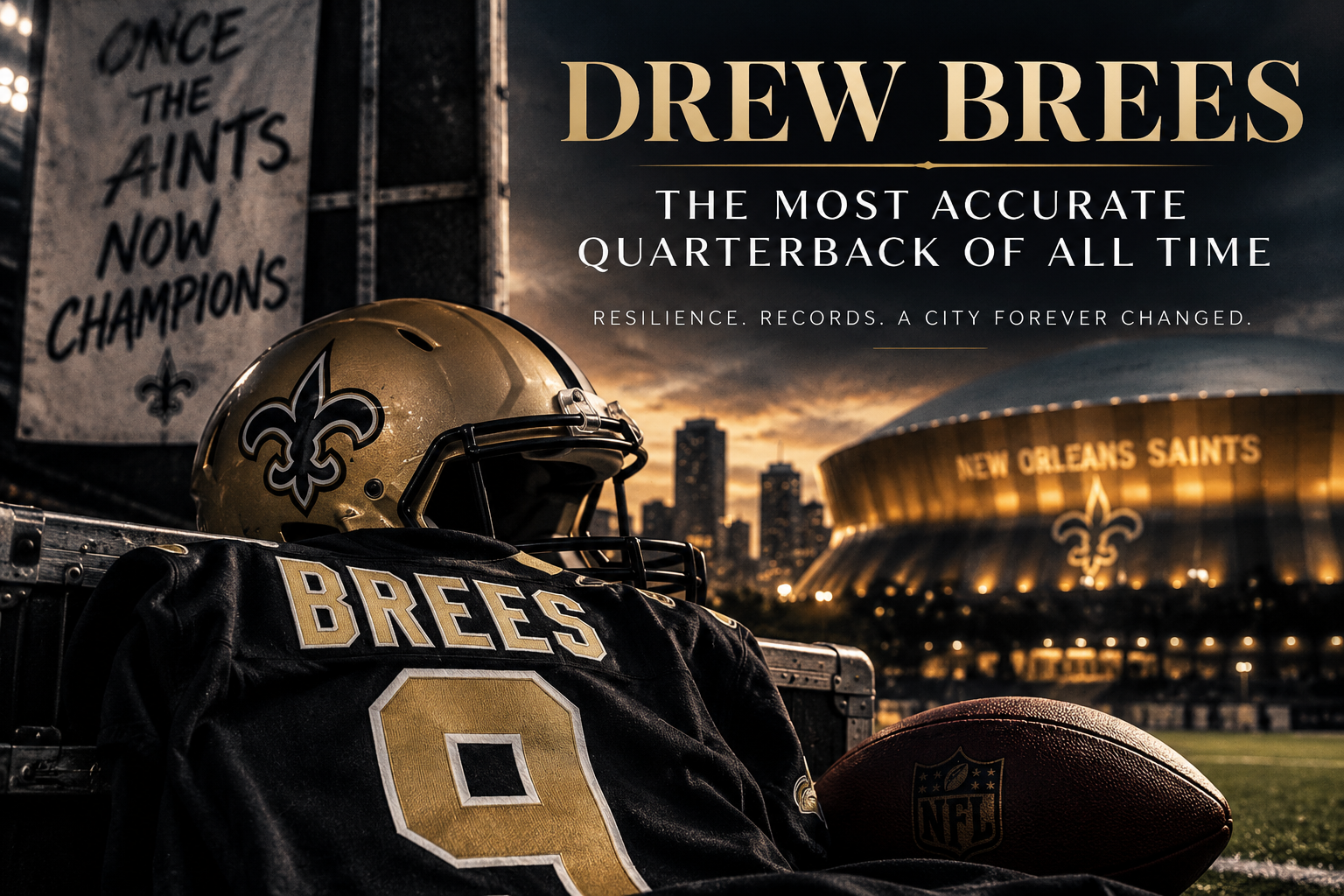
Too short. Too injured. Too late.
At different points in Drew Brees’ football life, there was always supposed to be a reason he couldn’t become an all-time great quarterback. He wasn’t tall enough. His arm wasn’t overwhelming enough. Then, just as his NFL career was beginning to take off, he suffered a devastating shoulder injury that threatened everything.
Brees answered every doubt.
By the time he walked away from football, he had a Super Bowl championship, a Super Bowl MVP, five 5,000-yard seasons and his name scattered throughout the NFL record book. He retired as the league’s all-time leader in passing yards, completions and attempts, and became the first quarterback ever to surpass 80,000 career passing yards.
But Drew Brees’ story was bigger than numbers.
He changed what an NFL quarterback could look like, and more importantly, he helped change an entire franchise and city.
Too Short
At roughly six feet tall, Brees never looked like the prototype NFL quarterback. Even after becoming one of the most prolific passers in Big Ten history at Purdue and leading the Boilermakers to their first Rose Bowl in 34 years, questions about his size followed him into the NFL Draft.
The San Diego Chargers eventually selected him 32nd overall in the second round of the 2001 NFL Draft. His career didn’t immediately explode, either. It took until 2004 for Brees to truly establish himself, earning Comeback Player of the Year and his first Pro Bowl selection.
It finally looked like Brees had proven he belonged.
Then everything nearly disappeared.
Too Injured
Late in the 2005 season, Brees suffered a devastating injury to his throwing shoulder. San Diego already had Philip Rivers waiting behind him, and suddenly Brees’ future with the Chargers was over.
He entered free agency with one enormous question hanging over him:
Would his shoulder ever be the same?
Miami had an opportunity to bring him in but ultimately went another direction amid concerns over the shoulder.
New Orleans took the chance.
It became one of the most important decisions in NFL history.
New Orleans Needed a Quarterback. Brees Needed New Orleans.
When Brees arrived in 2006, New Orleans was still recovering from the devastation of Hurricane Katrina. The Saints weren’t simply looking for a quarterback. The franchise needed a new beginning.
Brees needed one too.
Alongside new head coach Sean Payton, he became the face of one of the greatest transformations the league has ever seen. Over his 15 seasons in New Orleans, Brees threw for 68,010 yards and 491 touchdowns, while the Saints won seven NFC South titles and reached three NFC Championship Games.
A quarterback discarded after a devastating injury had found his home.
And four years after arriving, he delivered something New Orleans had never experienced.
One of the Greatest Super Bowl Runs Ever
Look at the quarterbacks standing between Drew Brees and the Lombardi Trophy during the 2009 postseason.
First came Kurt Warner, a two-time NFL MVP and Super Bowl champion, with the Arizona Cardinals. Brees threw three touchdowns and New Orleans won 45-14.
Then came Brett Favre, a three-time MVP and Super Bowl champion, with the Minnesota Vikings. Brees threw another three touchdowns as New Orleans survived 31-28 and advanced to the first Super Bowl in franchise history.
Waiting there was Peyton Manning, who had already won four MVP awards and would eventually become the first five-time MVP in NFL history.
Brees didn’t blink.
He completed 32 of 39 passes for 288 yards, two touchdowns and zero interceptions. New Orleans beat Indianapolis 31-17, Brees was named Super Bowl XLIV MVP, and the Saints were champions for the first time. Across the entire postseason, Brees threw eight touchdowns without a single interception.
Warner. Favre. Manning.
Three legendary quarterbacks.
Brees went through all three to reach the mountaintop.
Then He Started Attacking the Record Book
Winning the Super Bowl secured Brees’ legacy. What happened afterward turned his career into something statistically absurd.
In 2011, Brees threw for 5,476 yards and 46 touchdowns, breaking what was then the NFL’s single-season passing-yardage record. He ultimately produced five separate 5,000-yard seasons, still the most by any quarterback in NFL history.
He led the NFL in passing yards seven times and passing touchdowns four times. He made 13 Pro Bowls, won two Offensive Player of the Year awards and set an NFL record by throwing a touchdown pass in 54 consecutive games.
Brees eventually became the NFL’s all-time leader in completions and passing yards and the first quarterback in league history to cross 80,000 passing yards.
His final career résumé:
80,358 passing yards
571 passing touchdowns
7,142 completions
67.7% completion percentage
13 Pro Bowls
2× Offensive Player of the Year
Super Bowl XLIV Champion
Super Bowl XLIV MVP
Pro Football Hall of Fame Class of 2026
For a quarterback supposedly too small to dominate the NFL, Brees spent a good portion of his career rewriting its passing records.
The Most Accurate Quarterback of All Time
More than anything, Brees was defined by accuracy.
He finished his career completing 67.7% of his passes and repeatedly pushed the limits of what was possible. In 2018, at 39 years old, Brees completed an absurd 74.4% of his passes, setting what was then an NFL single-season record.
It wasn’t just checkdowns. Brees mastered anticipation, timing, throwing lanes and ball placement. He could consistently put the football exactly where his receiver needed it.
There have been quarterbacks with stronger arms and greater athleticism.
But when it comes to pure precision, Drew Brees has a legitimate claim as the most accurate quarterback of all time.
And he did all of this during a ridiculous era of quarterback play. Brees spent his prime competing with Tom Brady, Peyton Manning and Aaron Rodgers, then finished his career as Patrick Mahomes was beginning his rise. He may never have dominated the conversation the way those names did, but he still built a résumé and broke enough records to leave his own unmistakable mark on the era.
He Changed What an NFL Quarterback Could Look Like
This might be one of the most important parts of Drew Brees’ legacy.
NFL teams have always loved the prototype quarterback: tall, big arm, able to stand over the offensive line and see everything developing downfield.
Brees didn’t fit that mold.
And he didn’t overcome his height by becoming primarily a scrambling quarterback, either. He became one of the greatest pocket passers the sport has ever seen.
Brees learned how to manipulate throwing lanes, anticipate windows, move subtly inside the pocket and deliver the football with ridiculous accuracy. He proved that a quarterback around six feet tall could live from the pocket, throw for 5,000 yards, win a Super Bowl, break NFL records and become an all-time great.
He didn’t make NFL scouts stop caring about quarterback height.
He made height something a quarterback could overcome.
The league eventually became more willing to trust quarterbacks who didn’t fit the traditional size requirements. Russell Wilson succeeded at 5’11”. Kyler Murray became the No. 1 overall pick despite measuring around 5’10”. Bryce Young later went No. 1 overall at roughly the same height.
Those players earned their opportunities through their own talent, but Brees helped establish the precedent.
The path for the undersized NFL quarterback looked different after Drew Brees.
More Than a Quarterback
There are players who become synonymous with franchises. Then there are the rare players whose connection with a city becomes something deeper.
Before Drew Brees arrived, the Saints had spent decades as one of the NFL’s most unsuccessful franchises. During some of their darkest years, frustrated fans famously showed up to games wearing paper bags over their heads, embarrassed to be associated with a team they mockingly called the “Aints.”
That was the reputation of Saints football.
Then Drew Brees came to New Orleans.
He arrived in 2006 when both his career and the city needed a new beginning. Alongside Sean Payton, Brees helped turn a franchise that had once been a punchline into a perennial contender. Four years later, the same organization whose fans once hid their faces was celebrating a Super Bowl championship.
That’s why Brees’ legacy in New Orleans can’t be measured only in passing yards and touchdowns.
He didn’t just become the greatest quarterback in franchise history.
He helped change what it meant to be a Saints fan.
The Chargers drafted Drew Brees.
New Orleans made him a legend.
And Drew Brees gave New Orleans something it will never forget.
Liked What You Read?
Like the article and subscribe to Ethical Sports Takes for more Stories of Legends, rankings, debates and sports history.
Leave a Reply