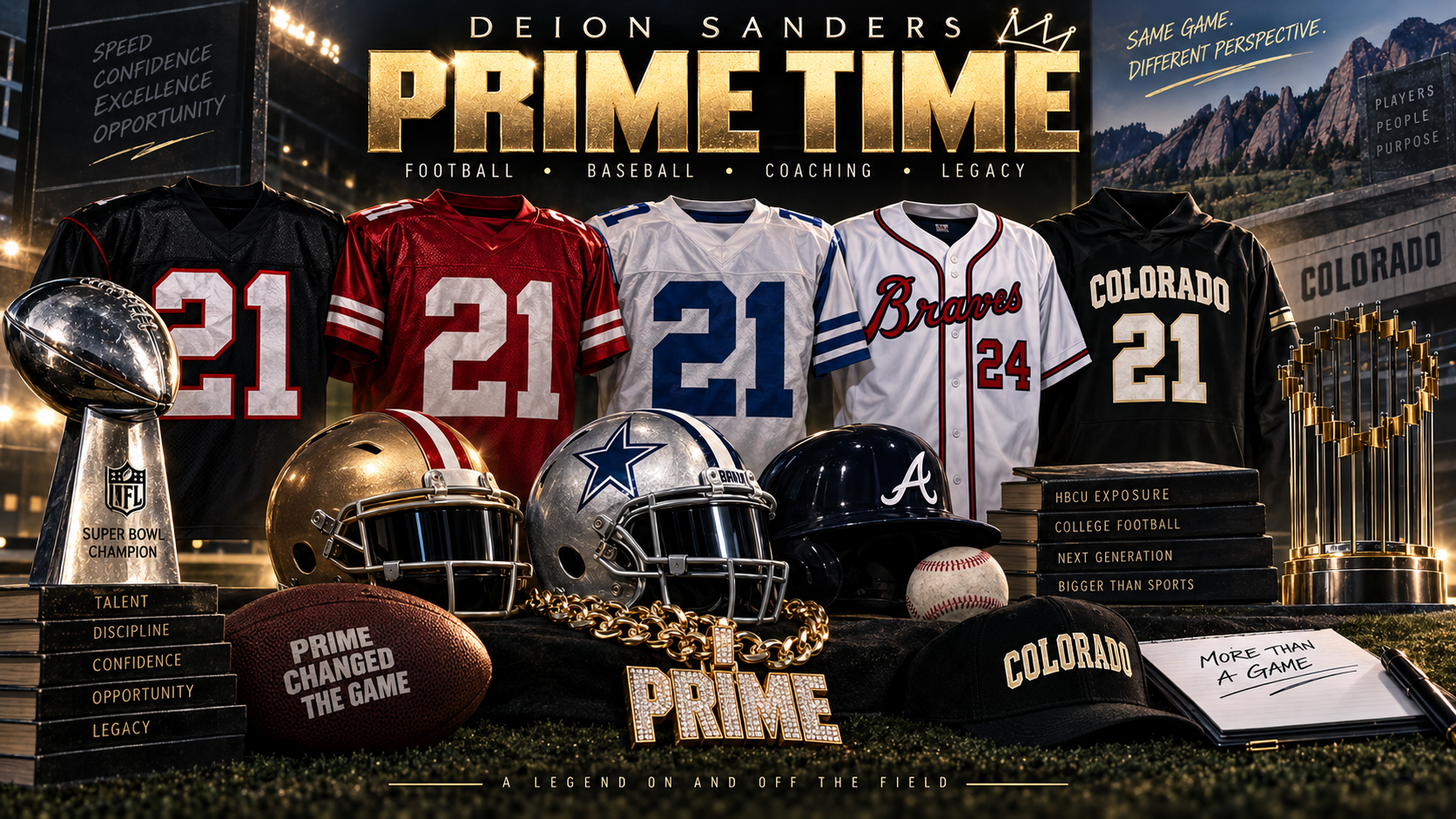
Prime Time was HIM.
There was no complicated game plan when it came to Deion Sanders. You simply looked at his side of the field and thought twice about throwing the football. Michael Irvin. Jerry Rice. Andre Rison. Cris Carter. The NFL was loaded with great receivers during Deion’s era, and Sanders lined up across from them with the same confidence every Sunday.
He talked. He danced. He celebrated. He had old school jerry curls. He told you exactly how good he was. Then the ball was snapped, and he backed up every word.
At his best, Deion could effectively erase an entire side of the football field. His speed gave him ridiculous recovery ability, his instincts made quarterbacks pay for mistakes, and once the football landed in his hands, he stopped looking like a cornerback and started looking like a return man.
The personality made him famous. The ability made him a legend.
“I’ll Be Gone Before Then”
If you want one story that perfectly explains the confidence of Deion Sanders, go back to before he had even played an NFL game.
At the 1989 NFL Scouting Combine, Sanders met with the New York Giants. The Giants handed him a thick book containing a test they wanted prospects to complete. Deion had a question of his own: What pick do you have?
When they told him they held the 18th pick, Sanders essentially laughed off the idea. He believed he would be long gone before the Giants ever had the opportunity to draft him, so there was no point wasting his time taking their test.
Deion went fifth overall to the Atlanta Falcons.
He knew.
That story could come across as arrogance from almost anyone else. With Deion, it became another example of the ridiculous confidence that defined Prime Time.
An Entire Side of the Field
Statistics have never told the complete story with shutdown corners. Deion finished his NFL career with 53 interceptions, but how many more opportunities would he have had if quarterbacks actually wanted to challenge him?
That was the problem. Throwing toward Deion could turn into six points going the other direction.
His speed allowed him to play with freedoms other cornerbacks simply couldn’t. He could bait quarterbacks into throws because he knew he had the acceleration to recover. He could stay with the fastest receivers in football, and he never backed away from facing the biggest names.
Michael Irvin and Jerry Rice weren’t simply good receivers. They were two of the greatest to ever play the position.
Deion still wanted the assignment.
Your best receiver against my best corner. Let’s see who wins.
And with Prime, offenses learned very quickly that sometimes the smarter decision was simply looking somewhere else.
1994: Prime Takes Over San Francisco
By 1994, the San Francisco 49ers had a problem. They were still one of the NFL’s premier organizations, but Dallas had become the team standing between them and another championship. The Cowboys had eliminated San Francisco in consecutive NFC Championship Games following the 1992 and 1993 seasons.
Then Deion arrived.
Sanders joined San Francisco for the 1994 season and produced one of the greatest years of his career. He intercepted six passes, returned them for 303 yards and three touchdowns, and was named NFL Defensive Player of the Year.
More importantly, the balance of power changed. San Francisco finally beat Dallas in the NFC Championship Game and went on to defeat the San Diego Chargers in Super Bowl XXIX.
The 49ers had finally gotten past Dallas.
With Prime.
So Dallas Went and Got Prime
Then came perhaps the greatest example of Deion’s value.
Dallas had won consecutive Super Bowls before San Francisco knocked them out of the 1994 NFC Championship Game. The rivalry had become the defining battle of the NFC, and now the 49ers had the best cornerback in football helping them get over the hump.
So what did Dallas do?
They went and got Deion.
Sanders became a free agent after his championship season in San Francisco, and Dallas signed him in 1995. One year Deion helped San Francisco get past Dallas and win the Super Bowl. The next year he was wearing a Cowboys uniform.
And Dallas immediately won the Super Bowl.
The Cowboys finished 12–4, made their way through the NFC playoffs, and defeated the Pittsburgh Steelers in Super Bowl XXX. Deion had just won back-to-back Super Bowls with two different franchises.
San Francisco needed him to get past Dallas. Then Dallas brought him over and went right back to the top.
If you want to understand how valuable Prime Time was at his peak, that tells you plenty.
Football Wasn’t Enough
And somehow, football was only half of the story.
Deion Sanders also played Major League Baseball. Not as a publicity stunt. Not in an exhibition. Actual Major League Baseball.
Sanders played parts of nine MLB seasons and reached the 1992 World Series with the Atlanta Braves. He remains the only athlete ever to appear in both a Super Bowl and a World Series.
Think about how ridiculous that is. Reaching the highest level of one professional sport is something almost nobody on Earth can accomplish.
Deion reached it in two.
More Than a Cornerback
Calling Deion Sanders a cornerback almost undersells what he could do. He returned punts. He returned kickoffs. He played some wide receiver. He intercepted passes and immediately became an offensive threat going the other direction.
Over his NFL career, Sanders scored touchdowns on interceptions, punt returns, kickoff returns, receptions, and a fumble recovery.
There were plenty of great defensive backs.
Prime was a weapon.
The Greatest Cornerback Ever
Deion Sanders finished his NFL career with 53 interceptions, nine interception-return touchdowns, eight Pro Bowl selections, six First-Team All-Pro selections, two Super Bowl championships, and an NFL Defensive Player of the Year award. In 2011, he was inducted into the Pro Football Hall of Fame.
His greatness wasn’t only recognized during his playing days. Deion was selected to the NFL 1990s All-Decade Team at both cornerback and punt returner, an incredible accomplishment by itself. He was later selected to the NFL 100 All-Time Team, placing Prime among the greatest players from the first century of professional football.
But we don’t need to complicate this.
Deion Sanders is the greatest cornerback to ever play football.
He could erase an entire side of the field. He lined up against some of the greatest receivers ever and welcomed the challenge. He could intercept a pass and take it to the house, return kicks, play offense, and somehow find time to play Major League Baseball too.
The swagger was real because the talent was real.
Deion told everyone he was Prime Time.
Then he spent his career proving it.
There have been plenty of great cornerbacks.
There has only been one Prime.
From Prime Time to Coach Prime
But Deion’s impact on football didn’t end when his playing career did.
Eventually, Prime Time became Coach Prime, and he brought the same ability to command attention with him.
At Jackson State, Deion went 27–6, won back-to-back SWAC championships, and brought national attention to HBCU football. He pushed for greater exposure for HBCU players and programs before eventually accepting the challenge of rebuilding Colorado.
When Deion arrived in Boulder, Colorado was coming off a 1–11 season. The Buffaloes improved to 4–8 in his first season before going 9–4 in 2024, including a 7–2 record in Big 12 play. The 2025 season was a major setback at 3–9, but Deion’s impact on the program and college football had already gone far beyond the win-loss column.
Colorado became must-watch television. Suddenly people across the country cared about Colorado football again. Whether they wanted to see Coach Prime win or wanted to see him lose, they were watching.
Then there was Travis Hunter.
Hunter followed Deion from Jackson State to Colorado and became one of the most remarkable two-way players college football has seen, eventually winning the 2024 Heisman Trophy while starring at both cornerback and wide receiver.
That feels fitting.
One of the greatest two-way athletes in sports history helped develop another player who refused to be limited to one side of the football.
Deion has always understood something bigger than X’s and O’s: attention has value. He brought it to Atlanta, San Francisco, and Dallas as a player. He brought it to Jackson State as a coach. Then he took a struggling Colorado program and made people across the country care about what happened in Boulder.
The results haven’t always been perfect, but the impact is impossible to ignore.
Prime Time never really went away. He just moved to the sideline.
Same game. Different perspective.
Like the article and subscribe to Ethical Sports Takes for more Stories of Legends, rankings, and sports discussions.
Leave a Reply