Winning Above Everything
Bill Russell did not care about your scoring title. He did not care about putting up 40 points every night. He cared about winning basketball games, and nobody in NBA history did that better.
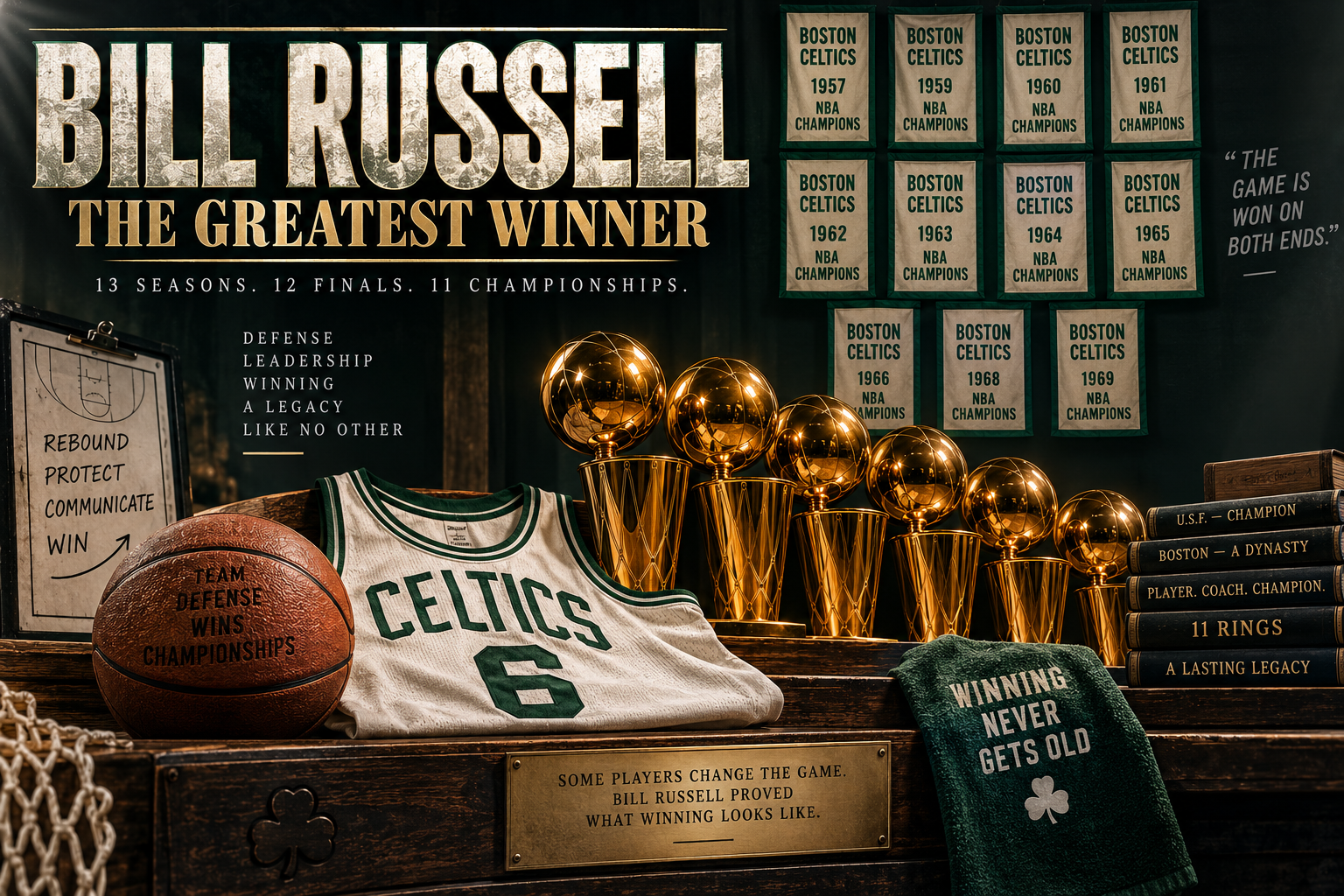
13 seasons. 12 trips to the NBA Finals. 11 championships.
That’s not a typo. Russell played 13 seasons in the NBA and walked away with the championship in 11 of them.
You can debate eras, statistics and competition all you want. The purpose of playing basketball is to win, and nobody built a career around winning quite like Bill Russell.
A Champion Before the NBA
Winning followed Russell before he ever reached Boston. At the University of San Francisco, he led the Dons to back-to-back NCAA championships in 1955 and 1956, establishing himself as one of the best defensive players in college basketball.
Russell then helped the United States win Olympic gold in 1956 before beginning his NBA career.
The Boston Celtics acquired Russell in a draft-day trade after he was selected second overall in the 1956 NBA Draft. Boston already had legendary coach Red Auerbach. What they were missing was the player who would become the foundation of the greatest dynasty in league history.
The Dynasty Begins
Russell’s impact was immediate. Boston reached the NBA Finals during his rookie season and defeated the St. Louis Hawks in seven games to win the 1957 NBA championship.
The Celtics lost in the Finals the following season, but what happened next remains one of the most ridiculous stretches of winning in American professional sports.
From 1959 through 1966, Boston won eight consecutive NBA championships.
Eight straight.
Players changed. Opponents changed. The league evolved. Russell remained in the middle of everything, protecting the rim, controlling the glass and anchoring Boston’s defense.
Defense Before We Could Measure It
One of the strangest things about looking back at Bill Russell’s career is that one of his greatest abilities isn’t properly represented in the record book.
The NBA did not officially record blocked shots until the 1973-74 season, years after Russell retired. So we will never have an official career block total for one of the greatest shot blockers and defensive players basketball has ever seen.
What we do have are the rebounds. Russell averaged 22.5 rebounds per game for his career and finished with 21,620 total rebounds, second only to Wilt Chamberlain in NBA history.
But Russell’s defense was about more than collecting rebounds or sending shots into the stands. His timing, positioning and ability to turn defensive plays into offense made him the centerpiece of Boston’s entire identity.
Russell vs. Wilt
If Wilt Chamberlain represented overwhelming individual statistics, Bill Russell represented winning.
Their rivalry became one of the defining matchups in NBA history. Wilt could produce numbers that looked impossible, but when his teams met Russell’s Celtics in the playoffs, Boston kept finding ways to survive.
Russell wasn’t going to match Wilt’s scoring numbers. He didn’t need to. He wanted the series, and more often than not, he got it.
That difference is one of the biggest reasons Russell sits ahead of Wilt on this list. Wilt owns records that may never be touched, but Russell owns something even harder to replicate:
11 championships.
Five MVPs
Russell’s scoring numbers sometimes cause people to underestimate just how highly he was regarded while he was actually playing.
He won five NBA MVP awards, with only Kareem Abdul-Jabbar winning more.
Even crazier, Russell won three consecutive MVPs from 1961 through 1963, making him one of only three players in NBA history to accomplish the feat alongside Wilt Chamberlain and Larry Bird.
The middle award might be the most impressive example of how highly Russell’s impact was valued. In 1961-62, Wilt Chamberlain averaged an absurd 50.4 points and 25.7 rebounds per game.
Bill Russell still won MVP.
Wilt produced one of the most ridiculous statistical seasons basketball has ever seen, and Russell was still considered the league’s Most Valuable Player.
Player. Coach. Champion.
Russell’s importance to basketball history extends far beyond what he accomplished as a player.
In 1966, Russell became the first Black head coach in NBA history when he took over as player-coach of the Celtics.
And he didn’t simply hold the position. He won.
Boston’s eight-year championship streak ended in 1967, but Russell led the Celtics back to the top in 1968 while serving as both player and head coach.
Then came 1969.
The Celtics entered the Finals against a loaded Los Angeles Lakers team featuring Wilt Chamberlain, Jerry West and Elgin Baylor. Boston won the series in seven games, giving Russell his 11th championship.
That was his final NBA game.
Bill Russell walked away from basketball the same way he had spent almost his entire career.
As a champion.
The Greatest Winner
Russell retired with a résumé that may never be replicated:
- 11× NBA Champion
- 5× NBA MVP
- 3× Consecutive NBA MVP — 1961-1963
- 12× NBA All-Star
- 11× All-NBA
- 4× NBA Rebounding Champion
- 21,620 Career Rebounds
- 22.5 Career Rebounds Per Game
- 2× NCAA Champion
- Olympic Gold Medalist
- NBA 25th Anniversary Team
- NBA 35th Anniversary Team
- NBA 50th Anniversary Team
- NBA 75th Anniversary Team
- Basketball Hall of Fame
There is one major award missing from that list: Finals MVP.
Not because Russell wasn’t good enough to win one. The award simply didn’t exist until 1969, the final season of his career.
Decades later, the NBA made sure his name would forever be connected to it.
The award is now called the Bill Russell NBA Finals Most Valuable Player Award.
There couldn’t be a more fitting name. The trophy given to the best player on the NBA’s biggest stage is named after the man who spent his career owning that stage.
Bill Russell wasn’t the greatest scorer ever. His career wasn’t built around individual statistics or offensive records.
It was built around winning.
13 seasons. 11 championships.
On our list of the five greatest centers in NBA history, Bill Russell comes in at number two.
Because when the entire point of the game is to win, it’s difficult to argue against the greatest winner basketball has ever seen.
Like the article and subscribe to Ethical Sports Takes for more NBA rankings, stories and sports coverage.
Leave a Reply