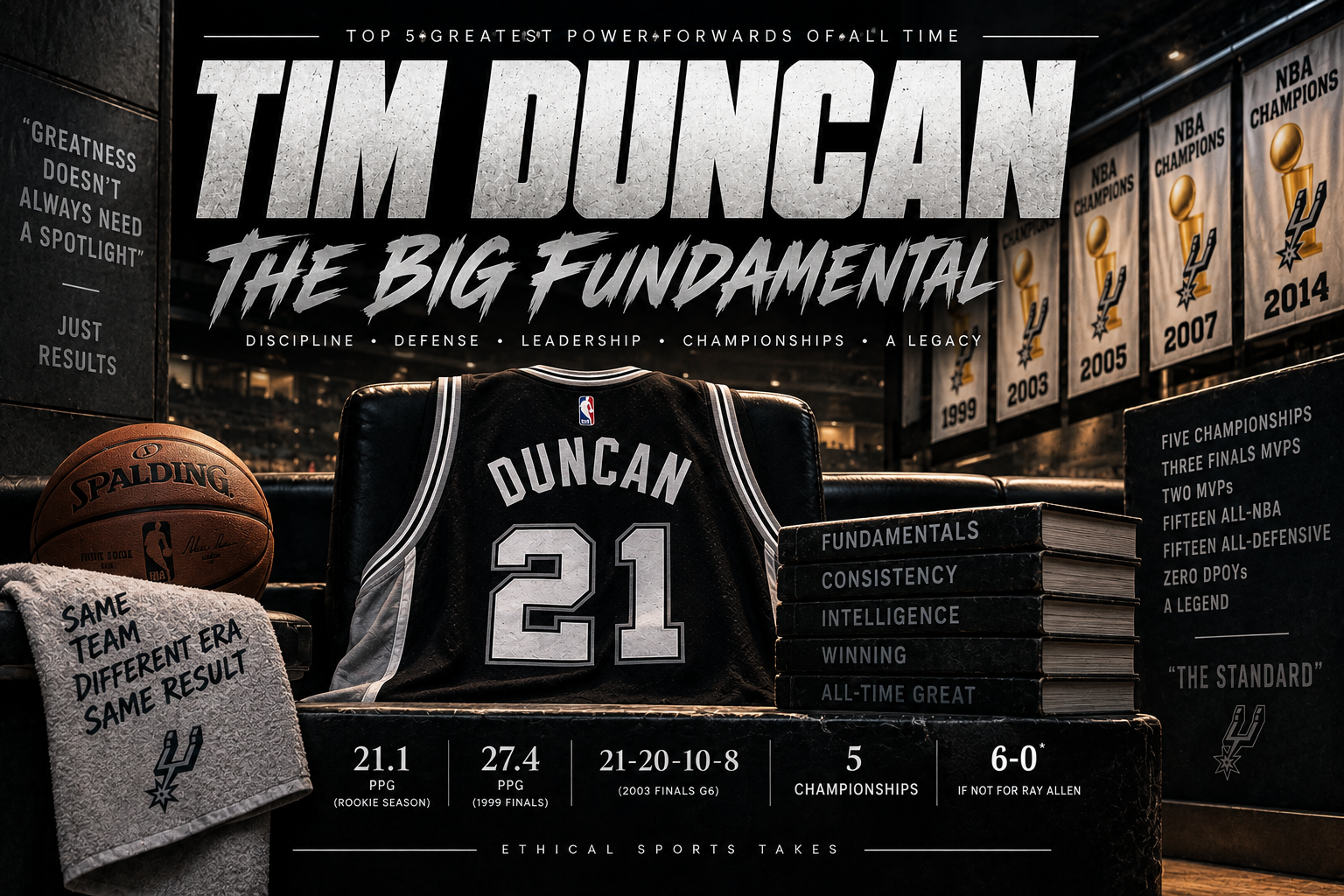
Ray Allen hit the greatest shot in NBA history. Without it, Tim Duncan would be 6-0 in the NBA Finals. Let that sink in. The exact same Finals record as the great Michael Jordan.
That is how close Tim Duncan came to having an almost flawless championship résumé.
And the crazy thing is, Duncan never needed the spotlight. He wasn’t flashy. He wasn’t loud. He wasn’t interested in building a brand around himself. He banked shots off the glass, protected the rim, grabbed rebounds, made the right play and won basketball games.
Again and again.
For nearly two decades, the San Antonio Spurs were one of the safest bets in professional sports, and Tim Duncan was the foundation underneath all of it.
Five championships. Three Finals MVPs. Two regular-season MVPs. Fifteen All-NBA selections. Fifteen All-Defensive selections.
The Big Fundamental wasn’t just great. He was the standard for the position.
Tim Duncan is our #1 greatest power forward of all time.
The Beginning of a Dynasty
When San Antonio selected Duncan with the first overall pick in the 1997 NBA Draft, they weren’t simply getting another great prospect. They were getting the player who would define their franchise for almost two decades.
Duncan immediately looked like he belonged among the NBA’s elite. As a rookie, he averaged 21.1 points and 11.9 rebounds per game, made the All-Star team and was selected to the All-NBA First Team.
One year later, he was an NBA champion.
In the lockout-shortened 1999 season, Duncan and David Robinson led San Antonio through the playoffs before defeating the New York Knicks in five games in the NBA Finals. Duncan averaged 27.4 points and 14.0 rebounds per game in the series and captured his first Finals MVP.
He was 23 years old.
The dynasty had begun.
Back-to-Back MVP
Duncan’s peak wasn’t built around highlight-reel plays or outrageous scoring numbers. It was complete control of a basketball game.
He won consecutive NBA MVP awards in 2002 and 2003, dominating with scoring, rebounding, defense and elite basketball IQ.
Then came the 2003 postseason.
Duncan led San Antonio past the three-time defending champion Los Angeles Lakers and eventually into the NBA Finals against the New Jersey Nets. In the championship-clinching Game 6, Duncan produced one of the most ridiculous Finals stat lines ever:
21 points. 20 rebounds. 10 assists. 8 blocks.
Two blocks away from a quadruple-double.
San Antonio won its second championship, and Duncan earned his second Finals MVP.
Five Championships Across Three Decades
Duncan’s greatness wasn’t confined to one short championship window.
He won his first title in 1999. Then came 2003, 2005, 2007 and finally 2014.
Think about that. Duncan won championships 15 years apart, adapting as the league changed and as San Antonio evolved around him.
He went from winning alongside David Robinson to forming the legendary trio with Tony Parker and Manu Ginóbili, and eventually becoming the veteran foundation of the beautiful basketball machine that demolished Miami in the 2014 NBA Finals.
Different teammates. Different eras. Different versions of Duncan.
Same result. Winning.
One Shot Away From 6-0
And then there is 2013.
San Antonio was seconds away from another championship. The Spurs led Miami late in Game 6 and were preparing to celebrate another title.
Then LeBron James missed a three. Chris Bosh grabbed the offensive rebound and kicked the ball to Ray Allen.
Allen backpedaled into the corner.
Bang.
Tie game.
Miami eventually won Game 6 in overtime and Game 7 two nights later.
That single shot prevented Duncan from winning his sixth championship and created one of the greatest “what ifs” in NBA history.
Without Ray Allen’s shot, Duncan very likely finishes his career 6-0 in the NBA Finals — the same Finals record as Michael Jordan.
Instead of allowing that loss to finish the story, Duncan and San Antonio came back the following season and demolished Miami in five games to win the 2014 championship.
That response might tell you more about Duncan than the hypothetical 6-0 record ever could.
The Greatest Power Forward Ever
Duncan’s résumé is ridiculous.
5-time NBA Champion
3-time NBA Finals MVP
2-time NBA MVP
15-time NBA All-Star
15-time All-NBA selection
15-time All-Defensive selection
And that last number deserves special attention.
Duncan was selected to an All-Defensive team 15 times, more than any player in NBA history. And somehow, he never won Defensive Player of the Year.
It is absurd that Tim Duncan does not have a DPOY.
This wasn’t simply a good defender who stuck around long enough to pile up selections. Duncan was one of the greatest defensive anchors the game has ever seen. He protected the rim, controlled the paint, rarely made mistakes and served as the backbone of elite San Antonio defenses for years.
The lack of a DPOY shouldn’t be held against Duncan. If anything, it is one of the biggest examples of an individual award failing to fully capture a player’s greatness.
His greatness wasn’t built around one skill. It was built around having almost no weaknesses. He could score in the post, hit the bank shot, rebound at an elite level, protect the rim, defend without constantly gambling, pass out of double teams and anchor an entire defensive system.
And most importantly?
He won.
Tim Duncan didn’t need to tell everyone how great he was. Nearly two decades of basketball did that for him.
Ray Allen’s shot may have kept Duncan from matching Michael Jordan’s perfect 6-0 Finals record, but five championships, three Finals MVPs, two MVPs and nearly two decades of sustained greatness are more than enough.
When it comes to power forwards, everyone else is fighting for second place.
Tim Duncan is the greatest power forward in NBA history.
Like the article? Subscribe to Ethical Sports Takes for more NBA rankings, debates and opinions.
Leave a Reply