When we talk about the greatest quarterbacks in NFL history, Troy Aikman’s name can sometimes get lost among players with enormous passing numbers and shelves full of individual awards.
But football isn’t played on a spreadsheet.
Troy Aikman was the quarterback at the center of one of the greatest dynasties the NFL has ever seen. His story stretches from Oklahoma to UCLA, from a 1–15 rookie season to three Super Bowl championships, and eventually to both the College Football Hall of Fame and the Pro Football Hall of Fame.
From Oklahoma to UCLA
Aikman’s college journey didn’t begin at UCLA.
He originally attended Oklahoma and played under Barry Switzer. After suffering a broken ankle during the 1985 season, Oklahoma shifted toward the wishbone offense with Jamelle Holieway at quarterback. Aikman’s skill set was built around throwing the football, so he eventually transferred to UCLA, a move that completely changed the trajectory of his career.
At UCLA, Aikman became one of the best quarterbacks in college football.
He went 20–4 as a starter across two seasons, leading UCLA to victories in the Aloha Bowl and Cotton Bowl. As a senior in 1988, Aikman became a consensus All American, won the Davey O’Brien Award as the nation’s top quarterback, and finished third in Heisman Trophy voting.
Across his two UCLA seasons, he completed 64.8 percent of his passes for 5,298 yards and 41 touchdowns.
His college career was eventually recognized with induction into the College Football Hall of Fame in 2008, and UCLA later retired his No. 8 jersey.
By the time the 1989 NFL Draft arrived, there wasn’t much mystery about where Aikman was going.
The Dallas Cowboys selected him first overall.
From 1–15 to a Dynasty
Aikman didn’t exactly walk into a contender.
Dallas was beginning a massive rebuild under new owner Jerry Jones and head coach Jimmy Johnson, and Aikman’s rookie season showed just how much work needed to be done.
The Cowboys finished 1–15 in 1989, with Aikman going winless in his 11 starts. He threw nine touchdowns against 18 interceptions and took plenty of punishment along the way.
It would have been difficult to imagine what was coming next.
Dallas began assembling one of the greatest collections of talent in NFL history. Aikman was joined by Emmitt Smith and Michael Irvin, creating the trio that became known as The Triplets. Around them was an incredible offensive line and a championship caliber defense.
And as the Cowboys improved, Aikman improved with them.
Dallas went 7–9 in 1990 and 11–5 in 1991 before everything came together in 1992.
The Cowboys went 13–3, stormed through the NFC and reached Super Bowl XXVII against the Buffalo Bills.
That’s where Aikman delivered arguably the defining performance of his career.
A Super Bowl Masterpiece
On the biggest stage in football, Aikman was nearly flawless.
He completed 22 of 30 passes for 273 yards and four touchdowns as Dallas defeated Buffalo 52–17. His performance earned him Super Bowl MVP, and the Cowboys were champions for the first time since the 1970s.
It wasn’t a one year wonder.
Dallas returned the following season and beat Buffalo again in Super Bowl XXVIII. Two years later, the Cowboys defeated Pittsburgh in Super Bowl XXX.
Three championships in four seasons.
Aikman became the first quarterback in NFL history to win three Super Bowls within a four year span.
That’s a dynasty.
More Than the Numbers
This is where I think Aikman’s career needs context.
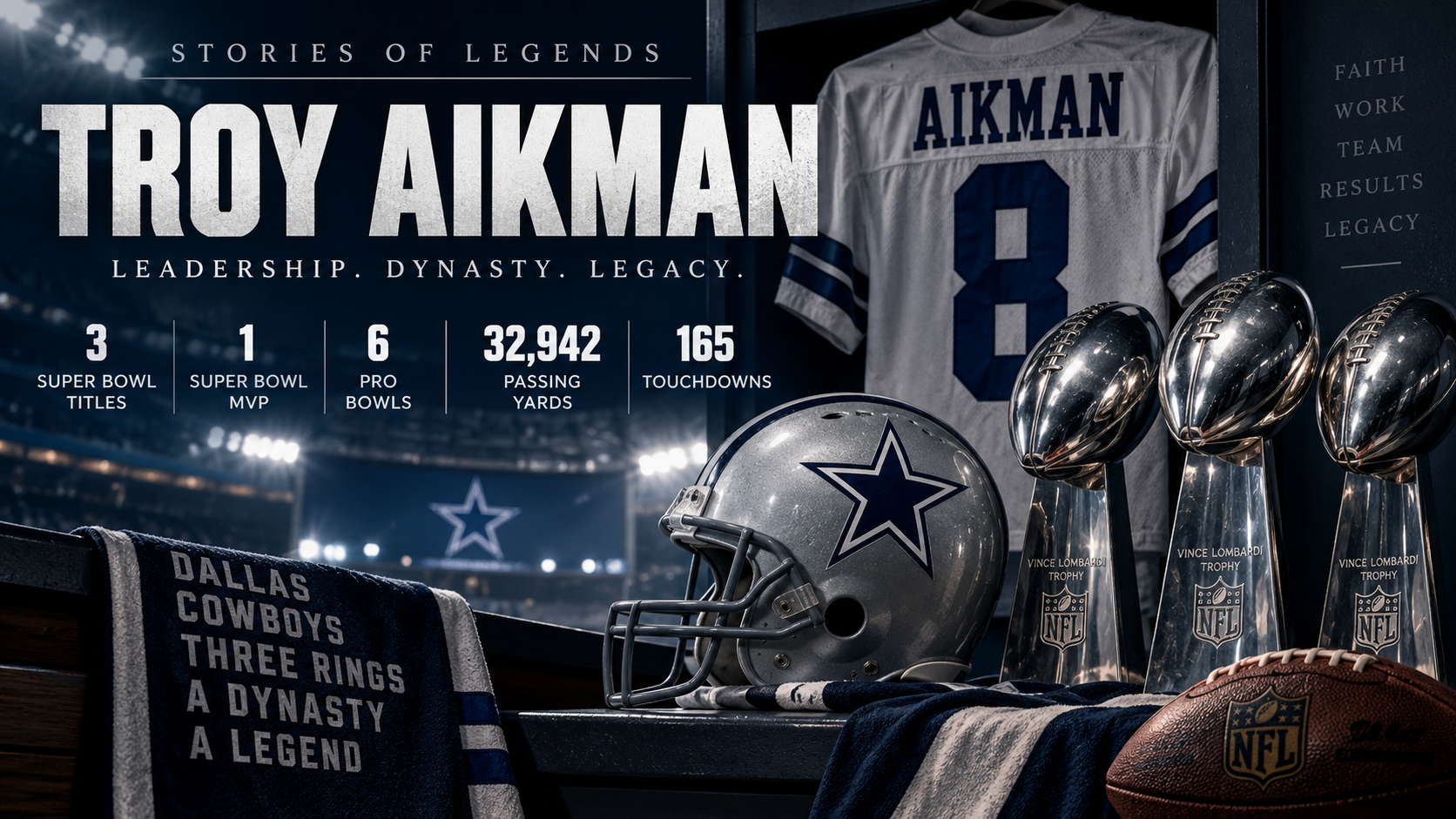
If you compare his statistics directly with quarterbacks playing today, they don’t look extraordinary. Aikman finished his career with 32,942 passing yards and 165 touchdowns. He never threw for 4,000 yards in a season and never produced the enormous touchdown totals we associate with modern superstar quarterbacks.
But he wasn’t playing modern football.
The Cowboys didn’t need Aikman throwing the ball 45 or 50 times every Sunday. They had the NFL’s all time leading rusher in Emmitt Smith, Michael Irvin outside and one of football’s greatest offensive lines.
Aikman’s job was to command the offense, make the throws Dallas needed and deliver when the stakes were highest.
And they won.
A lot.
Aikman recorded 90 victories during the 1990s, making him the winningest starting quarterback of any decade in NFL history at the time. Dallas reached the playoffs eight times during the decade, won six division titles, appeared in four NFC Championship Games and won three Super Bowls.
Interestingly, Aikman wasn’t selected to the NFL’s official 1990s All Decade Team, with Brett Favre and John Elway receiving the quarterback spots.
But that doesn’t diminish what Aikman accomplished.
Individual statistics tell us part of a player’s story. They don’t tell us all of it.
The End of an Era
Aikman’s body eventually began paying the price for more than a decade of NFL football. Injuries, including repeated concussions and back problems, accumulated toward the end of his career, and following the 2000 season, he retired.
He walked away as a three time Super Bowl champion, Super Bowl MVP and six time Pro Bowler, with nearly 33,000 career passing yards.
Then came Canton.
In 2006, Troy Aikman was inducted into the Pro Football Hall of Fame, permanently placing him among the legends of the sport. Two years later came his induction into the College Football Hall of Fame.
But retirement didn’t remove Aikman from football.
He moved into broadcasting and became one of the most recognizable voices covering the NFL, allowing an entirely new generation of fans who never watched him play to still grow up with Troy Aikman as part of their football experience.
The Legacy of Troy Aikman
Troy Aikman’s career is a reminder that greatness doesn’t always look the same.
Some quarterbacks build their legacies through statistical records. Some collect MVP awards. Some redefine what we believe is possible at the position.
Aikman’s legacy was built around winning.
He went from transferring colleges to becoming one of the best quarterbacks in college football. From the first overall pick to quarterbacking a 1–15 team. From losing every start of his rookie season to becoming Super Bowl MVP just a few years later.
Then he did something even more important.
He helped turn the Dallas Cowboys into the team of the 1990s.
Three championships in four seasons. Six Pro Bowls. A Super Bowl MVP. College Football Hall of Fame. Pro Football Hall of Fame.
You don’t need modern passing numbers to understand what Troy Aikman meant to football.
You just need to look at the trophies.
If you enjoyed this article, leave a like and subscribe to Ethical Sports Takes for more Stories of Legends, rankings, and sports opinions.
Leave a Reply