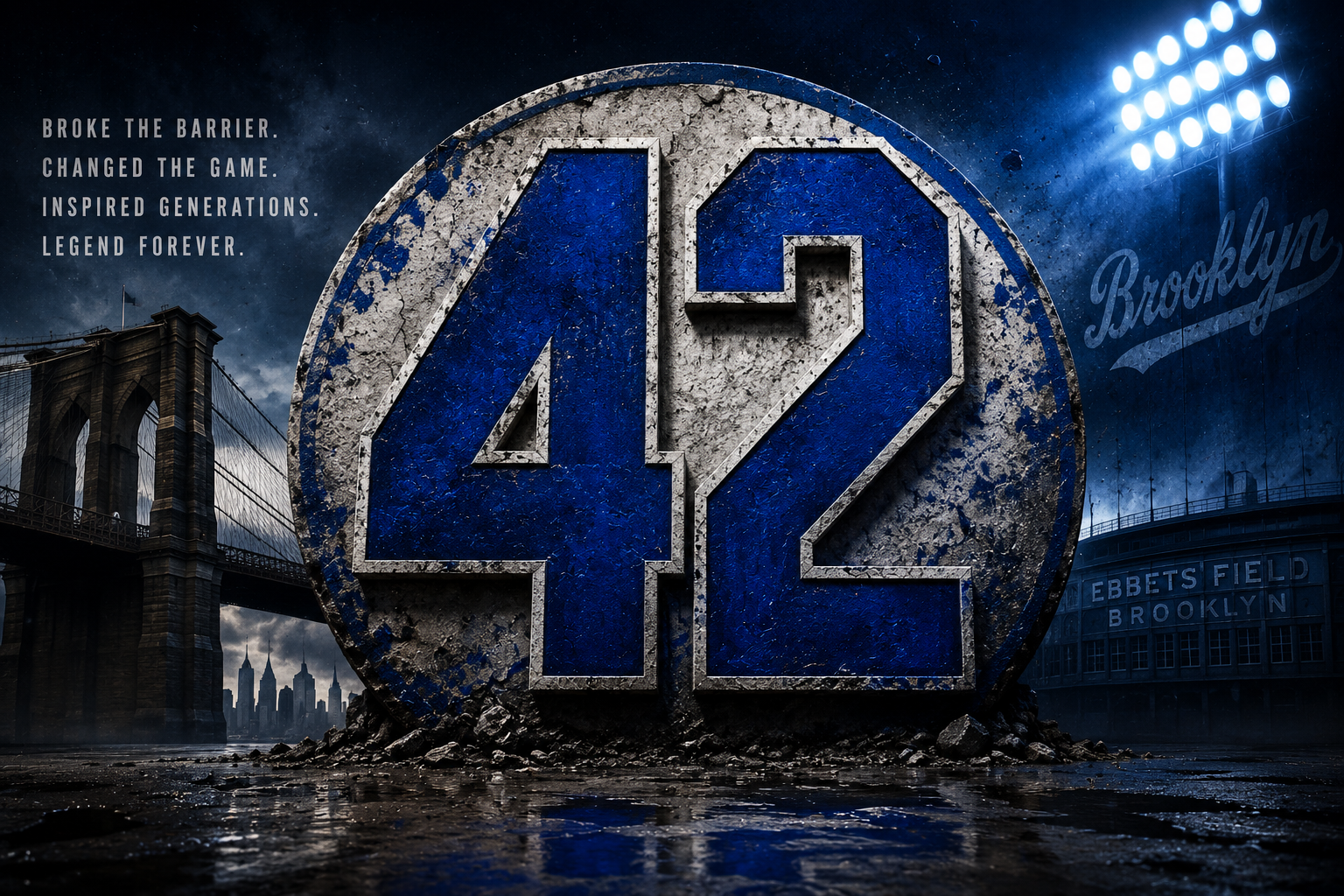
On April 15, 1947, Jackie Robinson walked onto a Major League Baseball field and changed the sport forever.
But when we talk about Jackie today, the historical importance of that moment can sometimes overshadow what happened next.
Jackie Robinson became one of the best baseball players in the world.
He wasn’t brought into Major League Baseball simply to make history. He had to prove he belonged while dealing with pressure, abuse and scrutiny that none of his teammates had to experience. Despite carrying all of that every time he stepped onto the field, Jackie didn’t just succeed.
He became an MVP, a World Series champion and eventually a Hall of Famer.
Jackie Robinson broke baseball’s color barrier, but his story didn’t end when he stepped onto the field for the first time.
That was only the beginning.
Breaking the Barrier
It is difficult to fully appreciate the pressure Jackie Robinson faced when he entered Major League Baseball. He wasn’t simply another rookie trying to prove that he belonged in the majors. His arrival represented something much bigger, and that meant virtually everything he did received attention.
Robinson faced racist abuse, hostility and threats while being expected to perform at baseball’s highest level. Yet when the games started, he gave people something else to talk about: how good he was.
Jackie hit .297, scored 125 runs and led the National League with 29 stolen bases during his first season as Brooklyn reached the World Series. He was rewarded by becoming the inaugural winner of the Baseball Writers’ Association of America’s Rookie of the Year Award.
The pressure could have overwhelmed him. Instead, Jackie immediately became one of Brooklyn’s most important players.
Jackie Robinson Was a Superstar
Only two years later, Jackie reached another level.
His 1949 season was phenomenal. Robinson hit .342 with 124 RBIs, 122 runs and 37 stolen bases, winning the National League batting title and being named NL MVP.
Think about how remarkable that is. In 1947, Jackie Robinson entered Major League Baseball carrying an enormous burden and wondering how he would be received. By 1949, baseball had to acknowledge him as the National League’s best player.
And it wasn’t one great season followed by a quick decline. Jackie became a six-time All-Star and helped Brooklyn win six National League pennants during his 10 seasons with the Dodgers.
The historical importance of Jackie Robinson is so enormous that his actual ability can sometimes become secondary when his career is discussed.
It shouldn’t.
Jackie Robinson was legitimately one of the great baseball players of his era.
Stealing Home in the World Series
If there is one play I would choose to show someone what Jackie Robinson was like on a baseball field, it happened during the 1955 World Series.
Brooklyn was playing its old rival, the New York Yankees, in Game 1 at Yankee Stadium. The Dodgers were trailing 6-4 in the eighth inning when Jackie reached third base.
Most players would have waited for the batter to bring them home.
Jackie Robinson decided he would do it himself.
With Whitey Ford pitching and Yogi Berra behind the plate, Jackie broke toward home and attempted one of baseball’s most daring plays.
He stole home in the World Series.
Jackie slid into the plate and was called safe, cutting the Yankees’ lead to 6-5. Berra immediately protested the call, creating an image and argument that would become part of baseball history.
Brooklyn eventually lost the game 6-5, but I love the play because it captures the way Jackie approached baseball. He wasn’t waiting around for something to happen.
He made things happen.
Stealing home is already one of the boldest things a baseball player can attempt. Jackie did it against the Yankees, at Yankee Stadium, in the World Series.
That’s a legendary moment.
Finally Becoming a Champion
Losing Game 1 didn’t matter in the end.
The Dodgers fought back and defeated the Yankees in seven games to capture the 1955 World Series, finally giving Brooklyn its first championship. It was Robinson’s only World Series title after several previous trips to the Fall Classic.
After everything Jackie had experienced since arriving in Brooklyn eight years earlier, he could finally add World Series champion to his résumé.
He played one more season before his Major League career ended after 1956.
Ten seasons.
That was all Jackie Robinson needed to permanently change baseball.
Number 42 Became Bigger Than a Jersey Number
Jackie was elected to the Baseball Hall of Fame in 1962 in his first year of eligibility. But decades later came an honor that demonstrated just how far his legacy had grown beyond Brooklyn.
In 1997, Major League Baseball permanently retired No. 42 throughout the league.
Not just the Dodgers.
Every team.
MLB also celebrates Jackie Robinson Day every April 15, with players throughout baseball wearing No. 42 in his honor.
At this point, 42 doesn’t simply identify the player who once wore it.
It represents Jackie Robinson.
More Than Baseball
Jackie’s greatness cannot be captured by comparing his numbers to every player who came before or after him. His legacy exists on a different level because what happened when he stepped onto a baseball field mattered beyond the final score.
He helped change who was allowed to play Major League Baseball and then answered anyone who questioned whether Black players belonged by becoming one of the league’s greatest players himself.
And somehow, while carrying pressure that none of his teammates could truly understand, Jackie still built a Hall of Fame career.
That combination is what makes him such a unique figure in sports history.
Jackie Robinson isn’t remembered simply because he was first. He made sure he would also be remembered because he was great.
Rookie of the Year. MVP. Six-time All-Star. World Series champion. Hall of Famer.
But even those accomplishments only tell part of his story.
Jackie Robinson didn’t just become a baseball legend. He became an American sports legend whose impact will outlive the game itself.
If you enjoyed the article, make sure to like and subscribe to Ethical Sports Takes for more stories of legends, rankings, opinions and sports content.
Leave a Reply