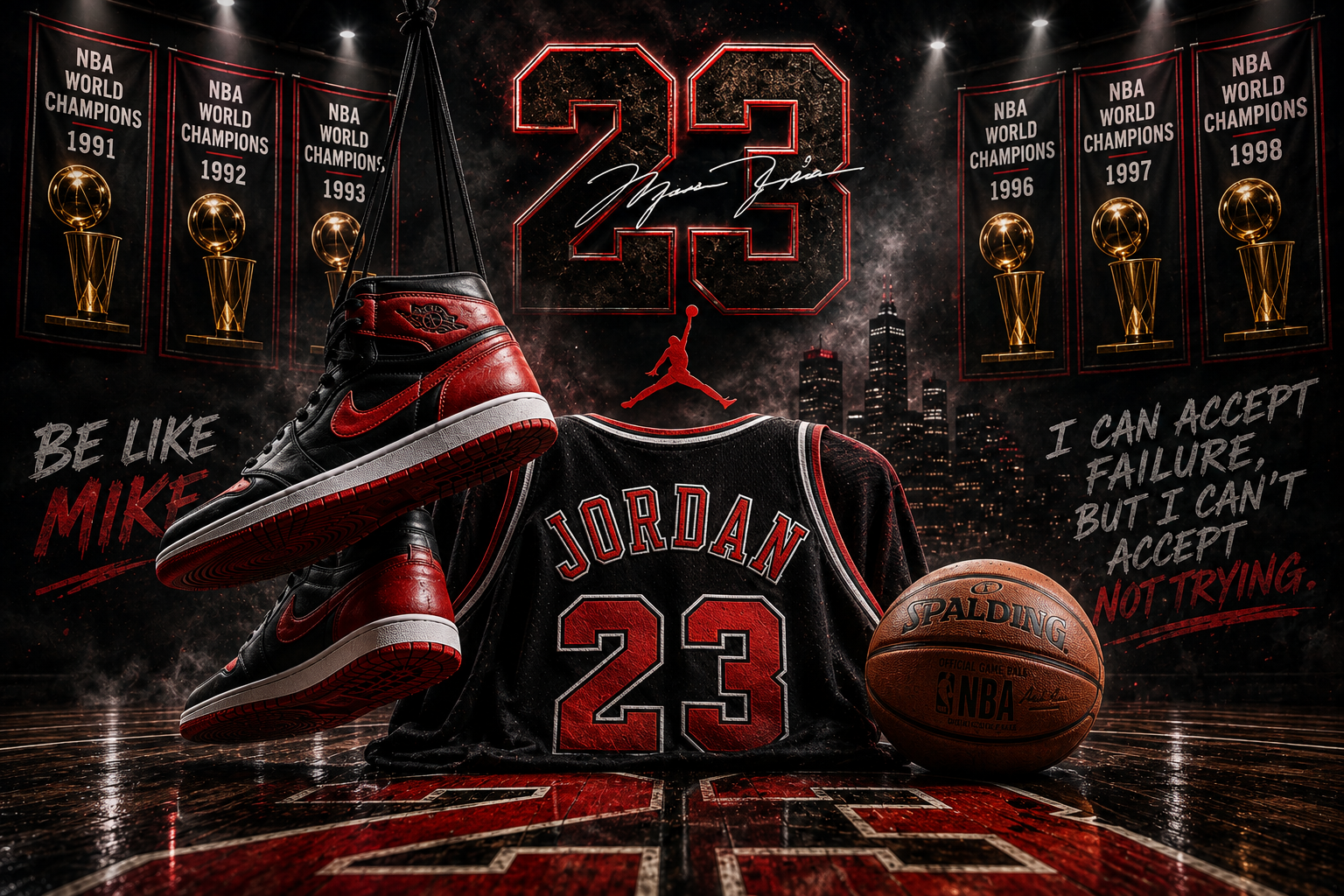
Michael Jordan fully transcended basketball. There are people who have never watched an NBA game in their lives who still know the number 23. They recognize the Jumpman logo. They know Air Jordans. They know the name Michael Jordan. That is how enormous his impact became.
Jordan was not simply the greatest basketball player of his generation. He became one of the most recognizable athletes in the history of sports and helped turn basketball into a truly global game. His influence stretched from the court to sneakers, fashion, advertising and popular culture.
But before the six championships, five MVPs, iconic shoes and worldwide fame, Michael Jordan was simply a kid from North Carolina trying to prove how good he could become. And long before he became an NBA legend, that journey started with a setback.
The Setback That Became Part of the Legend
One of the most famous stories about Jordan happened before millions of people even knew his name. As a sophomore at Laney High School, Jordan did not make the varsity basketball team. He instead played junior varsity, and that disappointment became part of the competitive fire that would eventually define his career.
Jordan kept working, grew, improved and eventually became one of the best high school players in the country. North Carolina came calling, giving Jordan the opportunity to play for legendary head coach Dean Smith. It would not take long for the rest of America to learn his name.
Before the NBA, There Was North Carolina
Jordan arrived at North Carolina in 1981 and immediately became an important part of one of the best teams in college basketball. As a freshman, he averaged 13.5 points and 4.4 rebounds while shooting an impressive 53.4 percent from the field.
North Carolina reached the 1982 National Championship Game against Georgetown, where Jordan was given his first opportunity to introduce himself to basketball history. With the Tar Heels trailing late, the ball found the 19 year old freshman. Jordan rose and knocked down the jumper that gave North Carolina the lead. The Tar Heels went on to win the national championship, and Jordan had delivered one of the biggest shots of his life before he had even finished his freshman season.
Looking back now, it almost feels like a preview of everything that was coming. When the moment got bigger, Michael Jordan wanted the ball.
Becoming the Best Player in College Basketball
Jordan did not simply live off that championship moment. He got much better.
As a sophomore, Jordan jumped from 13.5 points per game to 20.0 while averaging 5.5 rebounds and 2.2 steals. He shot 53.5 percent from the field and, during a season in which the college three point line was experimentally used in the ACC, knocked down 44.7 percent of his attempts from deep.
Then came his junior season. Jordan averaged 19.6 points, 5.3 rebounds, 2.1 assists, 1.6 steals and 1.1 blocks per game while shooting an absurd 55.1 percent from the field. North Carolina went 28 and 3 and finished the season ranked number one in the AP Poll.
Jordan was named ACC Player of the Year, AP Player of the Year, Naismith College Player of the Year and won the Wooden Award. He had officially become the best player in college basketball.
The Numbers Behind His Carolina Career
Jordan played 101 games during his three seasons at North Carolina and averaged 17.7 points, 5.0 rebounds, 1.8 assists and 1.7 steals while shooting 54 percent from the field. But some of the numbers beyond the basic stat line are even cooler.
Jordan scored in double figures in 90 of his 101 college games. North Carolina went 11 and 1 against top 10 opponents during his career. His career high was 39 points against Georgia Tech in 1983, and against rival Duke, Jordan averaged 22.7 points across seven games, including back to back 32 point performances.
During his final season at North Carolina, Jordan played alongside future NBA stars Sam Perkins, Brad Daugherty and a freshman point guard named Kenny Smith. Yet Jordan still stood above them all.
By the time he left North Carolina in 1984, his college résumé already included a national championship, one of the most famous shots in NCAA history, two Consensus First Team All American selections, ACC Player of the Year, the Wooden Award and the Naismith Award. He finished his Carolina career with 1,788 points while shooting 54 percent from the floor.
Then he declared for the NBA Draft. The Houston Rockets selected Hakeem Olajuwon first. The Portland Trail Blazers selected Sam Bowie second. With the third pick, the Chicago Bulls selected Michael Jordan.
Basketball was about to change forever.
Chicago Finds Its Superstar
It did not take long for the Bulls to realize what they had. Jordan averaged 28.2 points, 6.5 rebounds and 5.9 assists per game as a rookie while shooting 51.5 percent from the field. He was named Rookie of the Year and immediately established himself as one of the most exciting players in basketball.
By his third season, exciting was no longer enough to describe him. Jordan averaged an unbelievable 37.1 points per game.
The individual dominance was obvious, but what separated Jordan from almost every other great scorer was that scoring was only part of what he brought to the court.
Dominance on Both Ends
What made Michael Jordan so special was not simply his incredible offensive ability. Plenty of superstars throughout NBA history have been unstoppable scorers. Jordan combined that offensive dominance with an intensity on defense that made him a nightmare on both ends of the floor.
At his best, Jordan could spend the night carrying Chicago’s offense and then turn around and defend one of the opposing team’s best perimeter players. His athleticism, quick hands, anticipation and competitiveness made him an aggressive defender who constantly attacked passing lanes and pressured ball handlers.
The 1987 to 1988 season showed just how complete he had become. Jordan averaged 35.0 points per game and led the NBA with 3.2 steals per game. He won the scoring title, was named NBA MVP and somehow also won Defensive Player of the Year.
Think about how ridiculous that combination is. Jordan was simultaneously recognized as the best overall player in basketball, the best defensive player in basketball and the league’s leading scorer.
His defensive résumé continued growing from there. Jordan earned nine NBA All Defensive First Team selections, led the NBA in steals three times and finished his career with 2,514 steals.
Jordan’s defense also created offense. A deflection could become a steal, a steal could become a fast break and a fast break could end with Jordan flying toward the rim. Defense was not something he simply turned on occasionally. It was another way for him to impose himself on a game.
Perhaps the perfect example came during the final minute of his final game with Chicago. Everyone remembers the jumper over Bryon Russell that gave the Bulls the lead in Game 6 of the 1998 NBA Finals, but that possession only happened because of Jordan’s defense. Seconds earlier, he came from behind Karl Malone and knocked the ball away for a steal.
Even one of the greatest offensive moments of Jordan’s career began with a defensive play.
That was Michael Jordan. He did not just want to score more than you. He wanted to beat you on both ends of the floor.
The Detroit Wall
Being individually dominant did not immediately translate into championships.
The Eastern Conference was filled with powerful teams, and none caused Chicago more pain than the Detroit Pistons. Their physical style and famous Jordan Rules were designed specifically to make Jordan’s life difficult.
Detroit eliminated Chicago from the playoffs three consecutive times. For a player who would eventually become associated almost exclusively with winning, those losses were an important part of his story.
Jordan had to learn how to overcome them.
Finally Getting Past Detroit
By 1991, the Bulls were ready. Jordan had Scottie Pippen beside him, Phil Jackson had implemented the triangle offense and Chicago had developed into much more than a one man show.
The Bulls swept Detroit in the Eastern Conference Finals. The obstacle that had repeatedly ended Jordan’s championship dreams was finally gone.
Chicago then defeated Magic Johnson and the Los Angeles Lakers in the NBA Finals, giving Jordan his first championship and first Finals MVP. Then he did it again. And again.
The Bulls defeated Portland in 1992 and Phoenix in 1993. Jordan had gone from a superstar who supposedly could not get past Detroit to the leader of the NBA’s newest dynasty.
Three straight championships. Three straight Finals MVPs.
At 30 years old, Michael Jordan appeared to be on top of the basketball world.
Then everything changed.
Walking Away at the Top
In July 1993, Jordan’s father, James Jordan, was murdered. A few months later, Michael stunned the sports world by announcing his retirement from basketball.
He had just won three consecutive championships. He was arguably the best basketball player alive. And he walked away.
Jordan pursued baseball, a sport his father had loved and one they had discussed him playing. He spent 1994 in the Chicago White Sox organization, playing minor league baseball for the Birmingham Barons.
For the first time in years, the NBA continued without Michael Jordan at its center. Then, in March 1995, two words changed everything.
“I’m back.”
Number 45
Jordan returned to the Bulls late in the 1994 to 1995 season wearing number 45 instead of his famous 23. There were flashes of the old Jordan immediately, including a 55 point performance against the New York Knicks at Madison Square Garden.
But Chicago’s season ended against the Orlando Magic in the Eastern Conference Semifinals. For most players, returning after nearly two years away and immediately playing at an elite level would have been considered an incredible accomplishment.
For Jordan, losing was enough motivation. He returned the following season with something to prove.
The rest of the NBA paid for it.
72 Wins
The 1995 to 1996 Chicago Bulls became one of the greatest teams basketball had ever seen. Chicago finished the regular season 72 and 10, Jordan won the scoring title and league MVP, and the Bulls reached the NBA Finals before defeating the Seattle SuperSonics in six games.
The championship was clinched on Father’s Day. After the game, an emotional Jordan lay on the locker room floor holding the basketball and crying.
This championship was different. Basketball had its king back.
Three More
Chicago was not finished. The Bulls returned to the Finals in 1997 and faced the Utah Jazz. During Game 5, Jordan played despite being visibly ill and exhausted. He still scored 38 points and helped Chicago win one of the most famous games of his career.
The Bulls won the series. Five championships. Five Finals MVPs.
Then came 1998.
Everyone knew the dynasty might be approaching its end. Phil Jackson’s future in Chicago was uncertain, the roster was aging and the season carried the feeling of one final run.
Naturally, Jordan made sure it ended perfectly.
The Last Shot
Game 6 of the 1998 NBA Finals. Chicago led the series 3 to 2, but Utah led the game 86 to 85 in the final seconds.
Jordan stole the ball from Karl Malone. Chicago called no timeout. Jordan brought the ball up the floor, isolated against Bryon Russell, created space and rose for the jumper.
Good.
87 to 86 Chicago.
Utah failed to score on the final possession. The Bulls were champions again, and Jordan finished the game with 45 points.
Six championships. Six Finals MVPs. Two separate three peats.
And what appeared to be the perfect ending to one of the greatest careers sports had ever seen.
One More Return
Jordan retired again in 1999, but basketball still was not completely finished with him. In 2001, at 38 years old, he returned to play for the Washington Wizards.
This was not the Jordan who flew through the air in the 1980s or dominated the NBA during the 1990s. Age and injuries had taken away some of the athleticism that once made him seem almost superhuman.
Yet he could still play.
Jordan averaged more than 20 points per game in each of his two seasons in Washington and even scored 51 points in a game at 38 years old. There would be no championship ending this time, but there did not need to be.
His legacy had already been written.
More Than Basketball
Michael Jordan’s influence cannot be measured only by points, championships or MVP awards. Air Jordan became a cultural phenomenon. His partnership with Nike helped transform the relationship between athletes and sneakers forever, and the Jordan Brand eventually became one of the most recognizable names in sports and fashion.
Children around the world wanted to wear number 23. Players wanted to move like Jordan, shoot like Jordan and win like Jordan. His influence helped the NBA become an increasingly global product during the 1990s, and his fame stretched far beyond people who actually watched basketball.
Michael Jordan was not simply an NBA superstar. He became an icon.
The Legacy
Six NBA championships. Six Finals MVPs. Five league MVPs. Ten scoring titles. A Defensive Player of the Year award. Nine All Defensive First Team selections. Fourteen All Star selections.
And countless moments that became permanent pieces of basketball history.
Statistics can explain how dominant Michael Jordan was, but they cannot completely explain what Michael Jordan became. He represented competitiveness, performing under pressure and the belief that when the biggest moment arrived, somehow he would find a way to deliver.
Decades later, basketball fans still debate whether anyone has surpassed him as the greatest player to ever touch a basketball. Maybe that debate will never end.
But regardless of where anyone stands in the GOAT conversation, one thing should be undeniable.
There will never be another Michael Jordan.
If you enjoyed this edition of Stories of Legends, make sure to like and subscribe to Ethical Sports Takes for more stories about the athletes who changed sports forever.
Leave a Reply