Some athletes win. Some athletes dominate. And then there are the rare few who become so closely connected to a sport that it becomes impossible to tell its history without telling their story.
For Formula 1, Michael Schumacher is one of those names.
Seven World Championships. 91 Grand Prix victories. 68 pole positions. Five consecutive championships with Ferrari. Those numbers alone make Schumacher one of the greatest drivers ever to sit inside a Formula 1 car. But numbers don’t fully explain his legacy. Schumacher didn’t simply win races. He helped transform teams, changed expectations of what an F1 driver could demand from himself and became the centerpiece of one of the greatest dynasties motorsport has ever seen.
A Star Arrives
Michael Schumacher’s Formula 1 story began in 1991, and it didn’t take long for everyone to realize something special had arrived. He made his debut for Jordan at Spa and stunned the paddock by qualifying seventh despite having never raced at the circuit in Formula 1. His actual race lasted less than a lap because of a clutch problem, but sometimes you don’t need an entire race to make people pay attention.
Benetton certainly did.
Schumacher moved to Benetton almost immediately and by 1992 was already winning races. His first victory came at Spa, the same circuit where he had made his F1 debut only one year earlier. He finished third in the championship that season, ahead of Ayrton Senna, and the trajectory of his career was becoming obvious.
By 1994, Schumacher was a World Champion. In 1995, he did it again. Back to back championships with Benetton established him as the dominant force of a new generation. He could have stayed where he was comfortable and continued chasing championships.
Instead, he chose Ferrari.
Bringing Ferrari Back
Today, Ferrari and Formula 1 are almost inseparable. The red cars, the Tifosi, Monza and the Prancing Horse are part of the identity of the sport itself. But when Schumacher joined Ferrari in 1996, the team’s history was much stronger than its recent results.
Ferrari had not produced a Drivers’ World Champion since Jody Scheckter in 1979.
Schumacher wasn’t walking into a finished championship machine. He was joining a project.
Alongside figures such as Jean Todt, Ross Brawn and Rory Byrne, Schumacher helped build Ferrari into something terrifying. The success wasn’t immediate. There were painful championship defeats, reliability problems and years where they came agonizingly close. Schumacher lost the 1997 championship battle to Jacques Villeneuve, broke his leg at Silverstone in 1999 and watched another opportunity disappear.
But Ferrari kept building.
Then came 2000.
The Wait Was Over
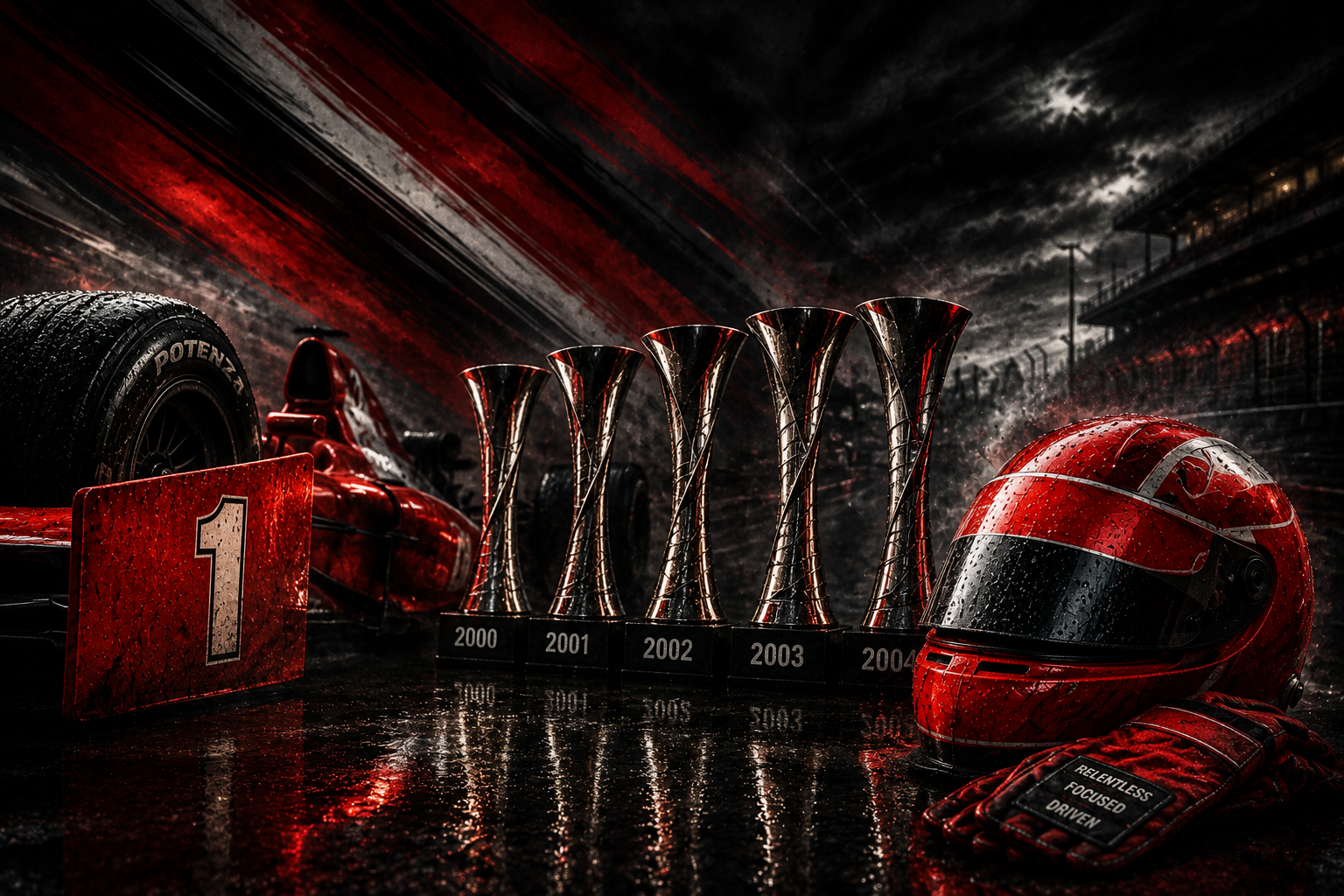
Twenty one years after Ferrari’s previous Drivers’ Championship, Michael Schumacher finally brought the title back to Maranello.
And once he started, he didn’t stop.
Schumacher won the championship again in 2001.
Then 2002.
Then 2003.
Then 2004.
Five consecutive Formula 1 World Championships.
No driver before or since has won five Drivers’ Championships in a row. Schumacher didn’t simply return Ferrari to the top. He helped create the most successful period in the history of one of the most famous teams in all of sports.
The 2002 and 2004 seasons in particular showed just how overwhelming the Schumacher and Ferrari combination had become. There was Schumacher’s relentless speed, but also his consistency, preparation and ability to deliver lap after lap when it mattered. He approached Formula 1 with an intensity that extended far beyond Sunday afternoon.
Ferrari wasn’t simply Michael Schumacher driving a fast red car. It was an entire organization operating around the pursuit of perfection, and Schumacher was at the center of it.
The Records Became Ridiculous
By the time Schumacher first retired at the end of 2006, the record book barely resembled the one that existed when he entered Formula 1.
Seven World Championships.
91 victories.
68 pole positions.
And perhaps most remarkably, 72 of those 91 victories came with Ferrari.
For years, Schumacher’s records looked almost untouchable. Eventually Lewis Hamilton came along and surpassed several of them while equaling Schumacher’s seven World Championships. But records being broken doesn’t diminish what Schumacher accomplished. If anything, the fact that it took another all time great driving through one of the greatest periods of team dominance in F1 history to reach those heights shows how extraordinary the original numbers were.
There is also something particularly special about Schumacher’s Ferrari legacy. Plenty of great drivers have driven for the Scuderia. Fernando Alonso tried to bring another championship to Maranello. Sebastian Vettel tried. Lewis Hamilton eventually arrived wearing red as well.
But the benchmark remains Schumacher.
One More Chapter
Schumacher originally walked away from Formula 1 after the 2006 season, but apparently seven championships and 91 wins weren’t enough to kill the racing bug.
In 2010, at 41 years old, he returned with Mercedes.
The comeback didn’t produce anything close to the results of his Ferrari years. Across three seasons Schumacher reached the podium only once. He was competing against a younger generation in machinery that wasn’t ready to challenge consistently at the front.
But even this chapter became part of his legacy.
At Monaco in 2012, Schumacher produced the fastest qualifying time, showing that even in his forties there were still flashes of the driver who had terrorized Formula 1 for years. A grid penalty meant he couldn’t start from pole, but the lap remained one final reminder of what Michael Schumacher could do behind the wheel.
More importantly, his contribution to Mercedes went beyond race results. Years later, Mercedes team principal Toto Wolff described Schumacher as one of the “founding fathers” of the success the team eventually enjoyed. Schumacher retired after 2012, Lewis Hamilton replaced him in 2013, and beginning in 2014 Mercedes became the next great Formula 1 dynasty.
Schumacher didn’t get to drive the dominant Mercedes cars that followed.
But he helped build before they arrived.
More Than Seven Championships
There will always be debates about the greatest Formula 1 driver of all time. Schumacher. Hamilton. Senna. Fangio. Verstappen. Different generations, different cars and completely different versions of Formula 1 make a definitive answer almost impossible.
But Michael Schumacher doesn’t need to win that debate for his place in history to be secure.
He arrived in Formula 1 and became a two time champion with Benetton. He then joined a Ferrari team that had waited more than two decades for a Drivers’ Championship and helped turn it into a dynasty. He won five championships in succession, accumulated 91 victories and retired with seven world titles. Then, after accomplishing virtually everything possible in the sport, he came back in his forties and helped a developing Mercedes operation that would eventually become Formula 1’s next dominant force.
Today, Schumacher and his family understandably live their lives privately. His skiing accident in December 2013 changed his life, and the details of his condition have largely remained where they belong: with his family. There is no need to speculate about any of it.
For Formula 1 fans, what remains public is more than enough.
The red helmet. The Ferrari. The records. The championships. The battles. The relentless pursuit of winning.
Michael Schumacher didn’t just become a Formula 1 legend.
He helped define an era of Formula 1.
And that is why Michael Schumacher will forever have a place in the Stories of Legends.
If you enjoyed this edition of Stories of Legends, make sure to like and subscribe to Ethical Sports Takes for more stories celebrating the athletes who left a permanent mark on sports.
Leave a Reply