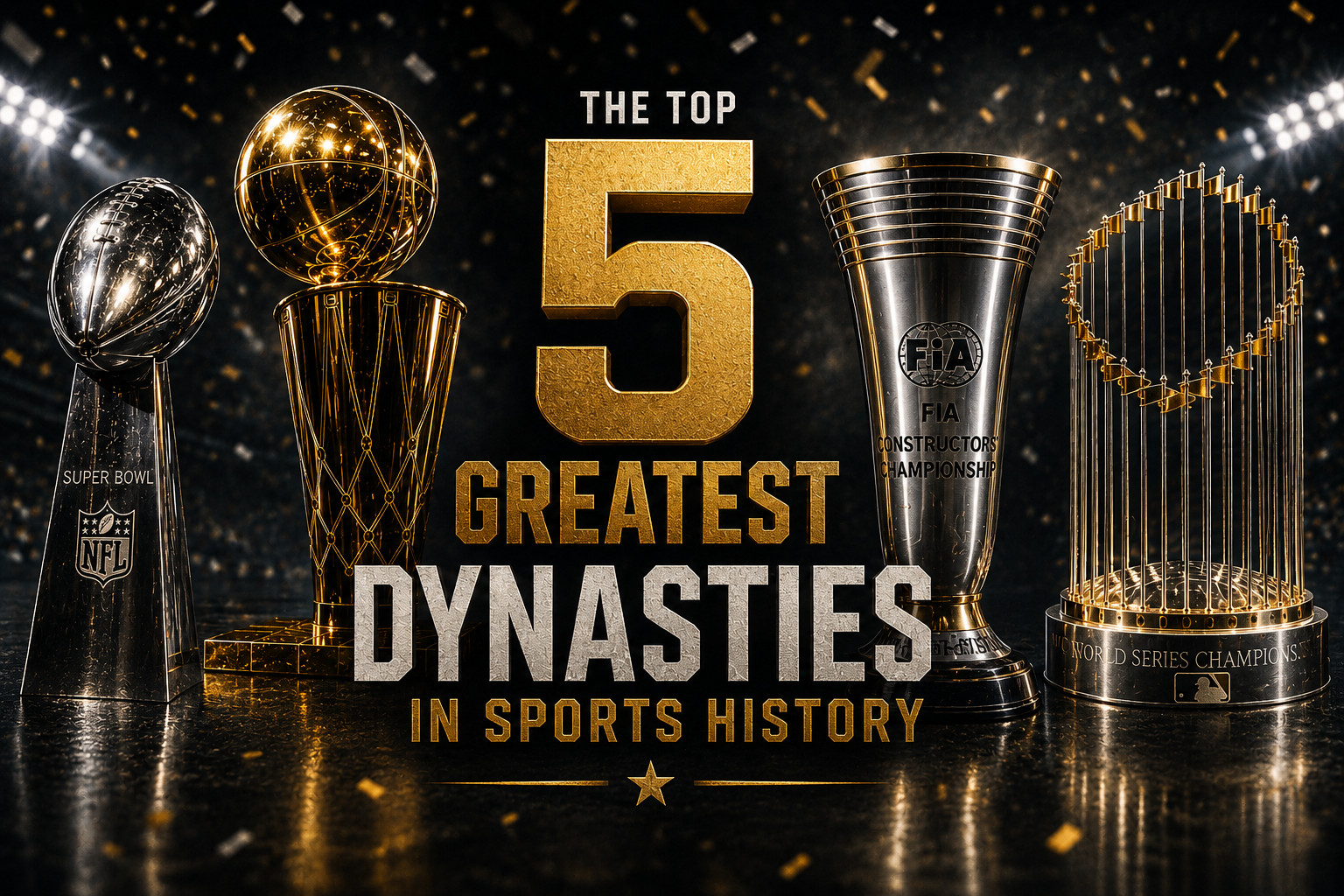
Dynasties are one of the hardest things to build in sports. Winning one championship is difficult enough. Winning repeatedly while every other team is trying to catch you is what separates a great team from a true dynasty.
For this list, I am looking at more than just the number of championships. Dominance, longevity, historical impact, competition and how completely a team controlled its era all matter. Comparing teams across different sports will never be perfect, and there are plenty of legendary dynasties that could make a list like this. But these five stand above the rest for me.
Honorable Mention — New York Yankees
It feels almost wrong to make a list of the greatest dynasties in sports history without mentioning the New York Yankees. Their most dominant stretch came from 1949 through 1953, when they won five consecutive World Series championships, something no MLB franchise has matched.
And that was hardly the only period in which the Yankees dominated baseball. Across different eras, the franchise was home to legends such as Babe Ruth, Lou Gehrig, Joe DiMaggio, Mickey Mantle and Yogi Berra, while building a championship history few organizations in any sport can rival.
Because this list focuses on five specific sustained dynasties rather than the total championship history of a franchise, the Yankees just miss my top five. But you can’t have a serious conversation about sports dynasties without acknowledging what they accomplished.
#5 — San Francisco 49ers: Five Championships and Two Legendary Quarterbacks
The San Francisco 49ers became one of the defining franchises in NFL history beginning with the arrival of Bill Walsh and Joe Montana. Walsh helped revolutionize offensive football with the West Coast offense, while Montana became one of the greatest quarterbacks the sport had ever seen. Their breakthrough came during the 1981 season when Montana’s touchdown pass to Dwight Clark produced “The Catch” against Dallas and sent San Francisco to its first Super Bowl.
The 49ers defeated Cincinnati in Super Bowl XVI and were only getting started. San Francisco won another championship following the 1984 season after going 15–1, but one of the most important moments of the entire dynasty came in the 1985 NFL Draft when the 49ers traded up and selected Jerry Rice with the 16th overall pick.
Rice would go on to become the greatest wide receiver in NFL history and gave San Francisco another superstar to pair with Montana. During the heart of the dynasty, Rice wasn’t simply along for the ride — he was one of the biggest reasons it continued. The 49ers won back-to-back championships following the 1988 and 1989 seasons, and Rice was spectacular in both. In Super Bowl XXIII, he caught 11 passes for 215 yards and a touchdown, earning Super Bowl MVP as San Francisco defeated Cincinnati 20–16. One year later, Rice caught three touchdown passes as the 49ers demolished Denver 55–10 in Super Bowl XXIV, still the largest margin of victory in Super Bowl history.
What makes the dynasty especially impressive is that it survived enormous change. Walsh retired, Montana eventually left and George Seifert and Steve Young took their places. Yet one constant remained at the center of the offense: Jerry Rice.
With Young now at quarterback, Rice continued dominating. San Francisco returned to the top following the 1994 season, defeating Dallas in the NFC Championship Game before crushing San Diego 49–26 in Super Bowl XXIX. Young threw a Super Bowl-record six touchdown passes, while Rice caught 10 passes for 149 yards and three touchdowns.
That championship gave San Francisco five Super Bowl victories in 14 seasons and made the 49ers the first franchise in NFL history to win five Super Bowls. The dynasty ultimately featured two legendary quarterbacks in Montana and Young, the greatest wide receiver ever in Rice, one of football’s greatest coaches in Walsh and a revolutionary offensive system that influenced generations of teams that followed.
Five championships, multiple eras of dominance and some of the greatest players ever to step onto a football field. The San Francisco 49ers open our list at number five.
#4 — Golden State Warriors: The Team That Changed Modern Basketball
Before the Golden State Warriors took over the NBA, conventional wisdom said a jump-shooting team couldn’t win championships. Then Stephen Curry and the Warriors changed basketball.
Golden State’s dynasty truly arrived during the 2014–15 season, when Curry won MVP and the Warriors went 67–15 before defeating LeBron James and the Cleveland Cavaliers in the NBA Finals. Somehow, the next season was even more ridiculous.
Golden State went 73–9, breaking the 1995–96 Chicago Bulls’ record for the most regular-season victories in NBA history. Curry became the first unanimous MVP in league history while producing one of the greatest offensive seasons basketball has ever seen. The season ended painfully with a 3–1 Finals collapse against Cleveland, but what happened next created arguably the most talented basketball team ever assembled.
Kevin Durant joined the Warriors.
Golden State went 67–15 in 2016–17 and then tore through the playoffs with a 16–1 record, defeating Cleveland in five games to win the championship. The Warriors repeated in 2018, giving them three championships in four seasons.
Durant eventually left, injuries devastated the roster and it looked like the dynasty had ended. Then came 2022. Curry, Klay Thompson and Draymond Green returned to the Finals and defeated Boston, giving Golden State its fourth championship in eight seasons.
The Warriors didn’t just win. They changed how basketball was played. Curry’s shooting stretched defenses farther from the basket than ever before, and teams throughout basketball began emphasizing three-point shooting, spacing and positionless lineups. Four championships, six Finals appearances in eight years, a 73-win season, a 16–1 postseason and an influence that reshaped the sport earn the Warriors number four.
#3 — Mercedes: Eight Straight Years on Top of Formula 1
Winning consistently in Formula 1 requires more than having the best driver. The car, engineering, strategy, reliability and entire organization have to work together. For nearly a decade, Mercedes did it better than everybody else.
The hybrid era began in 2014, and Mercedes immediately took control. With Lewis Hamilton and Nico Rosberg, the team produced a car the rest of the grid struggled to touch. Mercedes won the Constructors’ Championship in 2014, then again in 2015 and 2016. Hamilton and Rosberg battled each other for Drivers’ Championships during those years, with Hamilton winning in 2014 and 2015 before Rosberg finally defeated his teammate in 2016 and immediately retired.
Normally, losing a world champion would hurt a team. Mercedes simply kept winning. Valtteri Bottas joined Hamilton beginning in 2017, and Mercedes won another Constructors’ Championship. Then another in 2018, 2019 and 2020. Even in the chaotic 2021 season, when Max Verstappen ended Hamilton’s run of Drivers’ Championships, Mercedes still captured the Constructors’ title.
That made it eight consecutive Constructors’ Championships from 2014 through 2021, an F1 record. During that run, Mercedes also produced seven consecutive Drivers’ Championships, six belonging to Hamilton and one to Rosberg.
Few dynasties in any sport have controlled an era as completely as Mercedes controlled Formula 1’s hybrid era. Different regulations, different rivals and even a change at one of the driver seats couldn’t stop them. Eight straight constructors’ titles, seven straight drivers’ titles and one of the greatest drivers ever at the center of it all put Mercedes at number three.
#2 — New England Patriots: Two Decades of Winning
Most sports dynasties dominate for several years before eventually disappearing. The New England Patriots somehow remained championship contenders for almost two decades.
It began with the combination of Bill Belichick and Tom Brady. Brady entered the NFL as the 199th pick in the 2000 NFL Draft and became New England’s starter after Drew Bledsoe was injured in 2001. Months later, the Patriots were Super Bowl champions.
New England defeated the heavily favored St. Louis Rams in Super Bowl XXXVI, beginning one of the greatest runs in sports history. The Patriots then won consecutive championships following the 2003 and 2004 seasons, giving them three Super Bowls in four years.
Then something unusual happened. New England stopped winning championships for a while, but they never stopped winning. The Patriots continued dominating the AFC, produced the NFL’s first 16–0 regular season in 2007, and remained one of football’s most consistent contenders year after year.
A decade after their third championship, Brady and Belichick finally returned to the top by defeating Seattle in Super Bowl XLIX. Then came the legendary comeback against Atlanta in Super Bowl LI. New England trailed 28–3 before completing the largest comeback in Super Bowl history and winning 34–28 in overtime. Two seasons later, the Patriots defeated the Los Angeles Rams to win their sixth championship.
From the 2001 through 2018 seasons, New England won six Super Bowls, appeared in nine and reached 13 AFC Championship Games. That longevity is what makes this dynasty different. Players changed, coordinators changed, opponents changed and the NFL itself changed. Brady and Belichick remained.
For nearly 20 years, an entire generation of AFC teams knew their road to the Super Bowl would probably run through New England. Six championships across two distinct championship runs earns the Patriots number two.
#1 — Chicago Bulls: Six Championships, Two Three-Peats
Number one belongs to the Chicago Bulls of the 1990s, and the reason is simple: when Michael Jordan and the Bulls reached the NBA Finals, they didn’t lose.
Chicago’s first championship came in 1991 when Jordan, Scottie Pippen and head coach Phil Jackson defeated Magic Johnson and the Los Angeles Lakers. Then they won again in 1992 and again in 1993, completing their first three-peat.
Jordan then stepped away from basketball, and Chicago’s first run ended. When he returned, the Bulls didn’t merely become champions again. They became even more dominant.
The 1995–96 Bulls went 72–10, setting what was then the best regular-season record in NBA history. They finished the job by defeating Seattle in the Finals and beginning another three-peat. Chicago won again in 1997, culminating in Jordan’s legendary Flu Game during the Finals against Utah.
Then came 1998. With the dynasty approaching its end, the Bulls returned to the Finals against Utah. Game 6 produced one of the most iconic moments in basketball history: Jordan stripped Karl Malone, brought the ball down the floor and hit the championship-winning jumper over Bryon Russell.
The final résumé was almost perfect: six championships, six Finals appearances, six Finals victories and two separate three-peats in eight seasons. Jordan won Finals MVP all six times.
Pippen became one of the greatest two-way players ever. Dennis Rodman joined for the second three-peat and gave Chicago an elite rebounder and defender. Phil Jackson managed the personalities and built a system capable of sustaining greatness. And at the center of everything was Michael Jordan.
The Bulls didn’t simply dominate basketball during the 1990s. They became a global phenomenon. Their influence stretched far beyond the NBA and helped turn Jordan into one of the most recognizable athletes the world has ever seen.
There are dynasties that lasted longer, and there are teams that accumulated more championships over larger periods. But few dynasties combined dominance, perfection on the championship stage, cultural impact and iconic moments quite like Chicago.
Six championships in eight seasons, two three-peats and a perfect 6–0 record in the NBA Finals. For me, the 1990s Chicago Bulls are the greatest dynasty in sports history.
If you enjoyed this article, leave a like and subscribe to Ethical Sports Takes for more rankings, stories and opinions from across the world of sports.
Leave a Reply