Let’s make no secret about it: almost everybody wants financial success. People want enough money to live comfortably, take care of their families, enjoy their lives and have the freedom to do what they want.
But what happens when you’ve already won that game? What happens when you’re worth billions of dollars and another house, another car or another investment account isn’t really going to change your life?
Something I’ve noticed about many of the people who reach that level is that the hunger doesn’t necessarily disappear. Maybe they aren’t chasing money anymore, but they’re still chasing success. That’s part of how many of them became billionaires in the first place. So where do you go from there?
Maybe you buy a sports team.
And looking at what’s happening to franchise values across professional sports, I’m starting to wonder whether owning a sports franchise might be the ultimate billionaire investment.
The Numbers Are Getting Ridiculous
Forget about wins and losses for a moment and look at professional sports purely as a business.
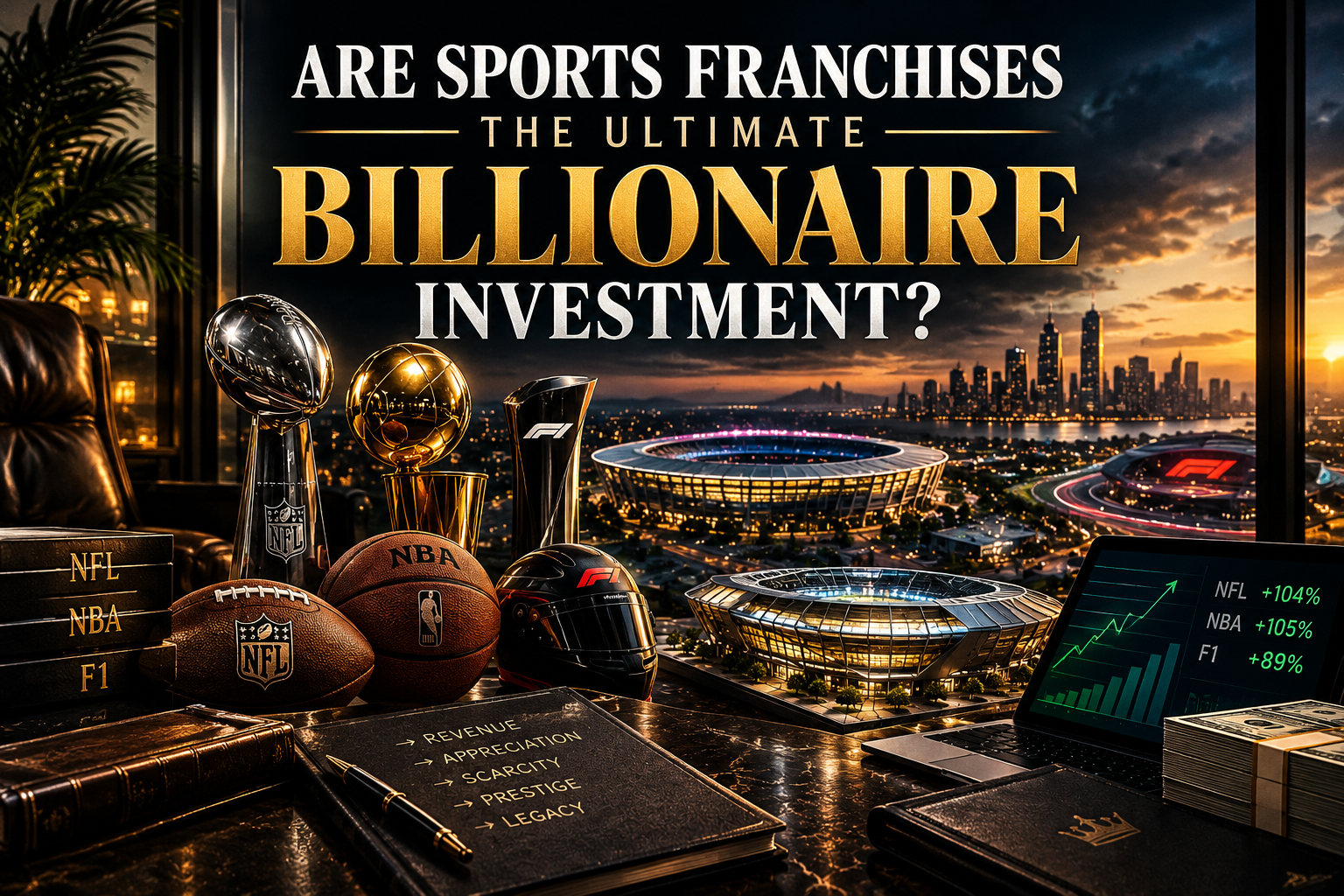
According to Forbes, the average NFL franchise was worth approximately $7.1 billion in 2025. Four years earlier, that number was roughly half as large. The average NFL franchise value increased 104% from 2021 to 2025.
The NBA isn’t far behind. Forbes estimated the average NBA franchise at $5.4 billion in 2025, up 21% in one year and more than double the approximately $2.5 billion average from just four years earlier.
Then there’s Formula 1. The average F1 team reached an estimated $3.6 billion valuation in 2025, an incredible 89% increase from 2023. Even Haas, the least valuable team on the grid in Forbes’ ranking, was valued at approximately $1.5 billion, while Ferrari led the way at an estimated $6.5 billion.
These aren’t normal rates of appreciation, and recent sales are showing us just how much wealthy investors are willing to pay to get into the club.
Look at What Just Happened With the Lakers
The Los Angeles Lakers might be the craziest recent example.
In 2025, Mark Walter acquired controlling ownership of the Lakers at a valuation of approximately $10 billion. Less than a year later, a group led by Josh Kushner and Bob Iger agreed to acquire controlling ownership at a $12.5 billion valuation.
That’s a $2.5 billion increase in the headline valuation in less than a year.
Let that sink in. We’re talking about billions of dollars in additional value associated with the same basketball franchise over a period in which most people wouldn’t even finish paying off a car.
Obviously, that doesn’t mean Walter simply pocketed a clean $2.5 billion profit. Ownership structures, transaction terms, taxes and other factors make these deals considerably more complicated than subtracting one valuation from another. But the underlying point remains: people with enormous amounts of money are willing to pay increasingly enormous amounts of money to own sports franchises.
The Seahawks Just Gave Us Another Example
Look at the Seattle Seahawks.
Paul Allen purchased the franchise in 1997 for approximately $194 million. His estate has now agreed to sell the Seahawks to the Khosla family for $9.612 billion, with NFL owners approving the transaction.
That’s almost difficult to comprehend.
And there’s something almost poetic about the timing. The Allen ownership era ended with Seattle as the defending Super Bowl champion, and now the franchise changes hands at the highest sale price in NFL history.
Buy a franchise, help build it into a successful organization, watch the NFL itself become exponentially more valuable, and then decades later the asset is worth billions more than the original purchase price.
That’s one heck of an investment.
Even the Broncos Show How Quickly Values Can Rise
You don’t even need to go back decades.
The Walton-Penner ownership group purchased the Denver Broncos for $4.65 billion in 2022, which at the time was itself a record price for an American sports franchise.
Forbes valued Denver at approximately $6.8 billion in 2025.
Again, these are estimates rather than guaranteed sale prices, but the trend across the industry is difficult to ignore.
Sports franchises keep getting more expensive.
Why Do Sports Teams Keep Becoming More Valuable?
The answer starts with one incredibly powerful concept: scarcity.
There are only 32 NFL franchises, only 30 NBA franchises, and Formula 1 has an extraordinarily limited number of teams. You can’t wake up tomorrow with $10 billion and simply create the 33rd NFL team. You need the league, you need approval, and unless expansion occurs, somebody who already owns a franchise has to actually be willing to sell it to you.
That creates an asset with a naturally limited supply while the pool of billionaires capable of buying one continues to grow.
Formula 1 might be the clearest example. The average F1 team increased dramatically in value in only a couple of years while investors continue trying to find ways into a grid with extremely limited space.
Basic economics tells you what happens when demand rises while supply barely moves: prices go up.
Everybody Loves Sports
There’s another advantage that separates sports franchises from many other investments: people care about them emotionally.
Millions of fans don’t simply consume NFL football because it’s another television program. Their team becomes part of their identity. Parents pass fandom down to their children. People buy jerseys, attend games, pay for streaming packages, travel to playoff games and spend decades following the same franchise.
That creates something incredibly valuable: loyal customers who don’t necessarily leave when the product gets bad.
The Dallas Cowboys haven’t won a Super Bowl since the 1995 season, and they’re still the most valuable sports franchise on Earth. Forbes valued Dallas at $13 billion in 2025, up dramatically from only a few years earlier.
Try running most normal businesses badly for 30 years and dramatically increasing their value anyway.
Sports are different.
You’re Buying More Than a Business
This is where I think sports ownership becomes especially attractive for billionaires.
If you’re worth $20 billion, you don’t necessarily need another conventional investment. You can already own stocks, you can already own real estate, and you can already invest in private companies.
A sports franchise gives you something those assets can’t completely replicate: prestige.
You don’t simply own shares in a company. You own the Lakers. You own the Broncos. You own an F1 team.
You get to sit courtside, hold the championship trophy, participate in league decisions and potentially become part of the history of a team followed by millions of people.
And if you’re someone who became extraordinarily successful because you’re addicted to competition, sports ownership gives you another scoreboard. Your business career may have already made you a billionaire. Now you can try to win a championship.
But Is It Actually the Perfect Investment?
Not quite.
Sports franchises aren’t risk-free, and calling them guaranteed investments would be ridiculous. They’re extremely illiquid. You can’t sell an NFL franchise tomorrow morning like you can sell a stock. There are league restrictions on ownership and debt. Stadium situations can become enormously expensive. Teams can lose money operationally, and spending billions on one franchise creates far more concentration risk than owning a diversified investment portfolio.
There’s also no guarantee that the enormous valuation increases of the last decade will continue forever. At some point, prices could become too high.
That’s why comparing buying an NFL franchise directly to putting money into something like the S&P 500 isn’t entirely fair. For the average investor, a diversified portfolio is obviously far more practical, liquid and accessible.
But billionaires operate under different rules.
If you already have enough diversified wealth that locking several billion dollars into one asset doesn’t threaten your lifestyle or financial security, the equation changes dramatically.
The Ultimate Billionaire Asset
That’s ultimately why I find sports franchises so fascinating as investments. They combine things that rarely exist together in one asset: extreme scarcity, enormous media revenues, loyal customers, cultural relevance, prestige, personal enjoyment and historically incredible appreciation.
The average NFL franchise value increased 104% from 2021 to 2025. The NBA’s average franchise value more than doubled over roughly the same period. Formula 1’s average team value increased 89% from 2023 to 2025.
Meanwhile, franchises continue changing hands for numbers that would have sounded absurd only a few years ago. The Lakers were valued at $12.5 billion in their latest deal. The Seahawks sold for $9.612 billion. The Broncos went for $4.65 billion in 2022, and even that enormous number already looks dramatically different in today’s sports market.
Could a billionaire put those billions into the stock market instead? Of course. Could they buy businesses, real estate or almost anything else imaginable? Absolutely.
But if you’ve already accumulated more money than you could reasonably spend in a lifetime, why wouldn’t you consider owning something that millions of people love, only a handful of people on Earth can ever possess, gives you another arena in which to compete and has historically appreciated at an extraordinary rate?
Maybe the ultimate billionaire purchase isn’t another yacht. Maybe it’s a sports team.
And if I were a billionaire, I know exactly where I’d put my money: I’d buy a sports franchise. You get to own something you’re passionate about, compete for championships and potentially watch an incredibly scarce asset continue to grow in value at the same time.
Sounds like a pretty good investment to me.
If you enjoyed this article, leave a like and subscribe to Ethical Sports Takes for more conversations about sports, business and everything happening beyond the field.
Leave a Reply