The San Antonio Spurs are a very odd team when you look back at NBA history. Over roughly two decades, they had an incredible collection of talent come through San Antonio. David Robinson was already one of the greatest centers ever. Tim Duncan became arguably the greatest power forward of all time. Tony Parker and Manu Ginóbili became Hall of Famers, and toward the end of the run, Kawhi Leonard developed into another superstar.
Think about that for a second. Over the course of this dynasty, the Spurs had five players who have legitimate arguments as top-50 players in NBA history: Robinson, Duncan, Parker, Ginóbili and Leonard. Obviously, they weren’t all in their primes at the same time, but having that much all-time talent pass through one organization during a single extended period of contention is insane. And overseeing almost all of it was Gregg Popovich, who has a legitimate argument as the greatest head coach in NBA history.
But were the Spurs actually a dynasty?
They won five championships between 1999 and 2014, which sounds like an obvious yes. But when you look closer, San Antonio’s run is completely different from what we traditionally picture when we hear the word dynasty.
The Michael Jordan Bulls won six championships through two separate three-peats. The Showtime Lakers won five championships during the 1980s and repeatedly returned to the Finals. The Shaq and Kobe Lakers won three straight championships from 2000 through 2002. Later, the Warriors won three championships in four seasons and reached five consecutive NBA Finals.
The Spurs?
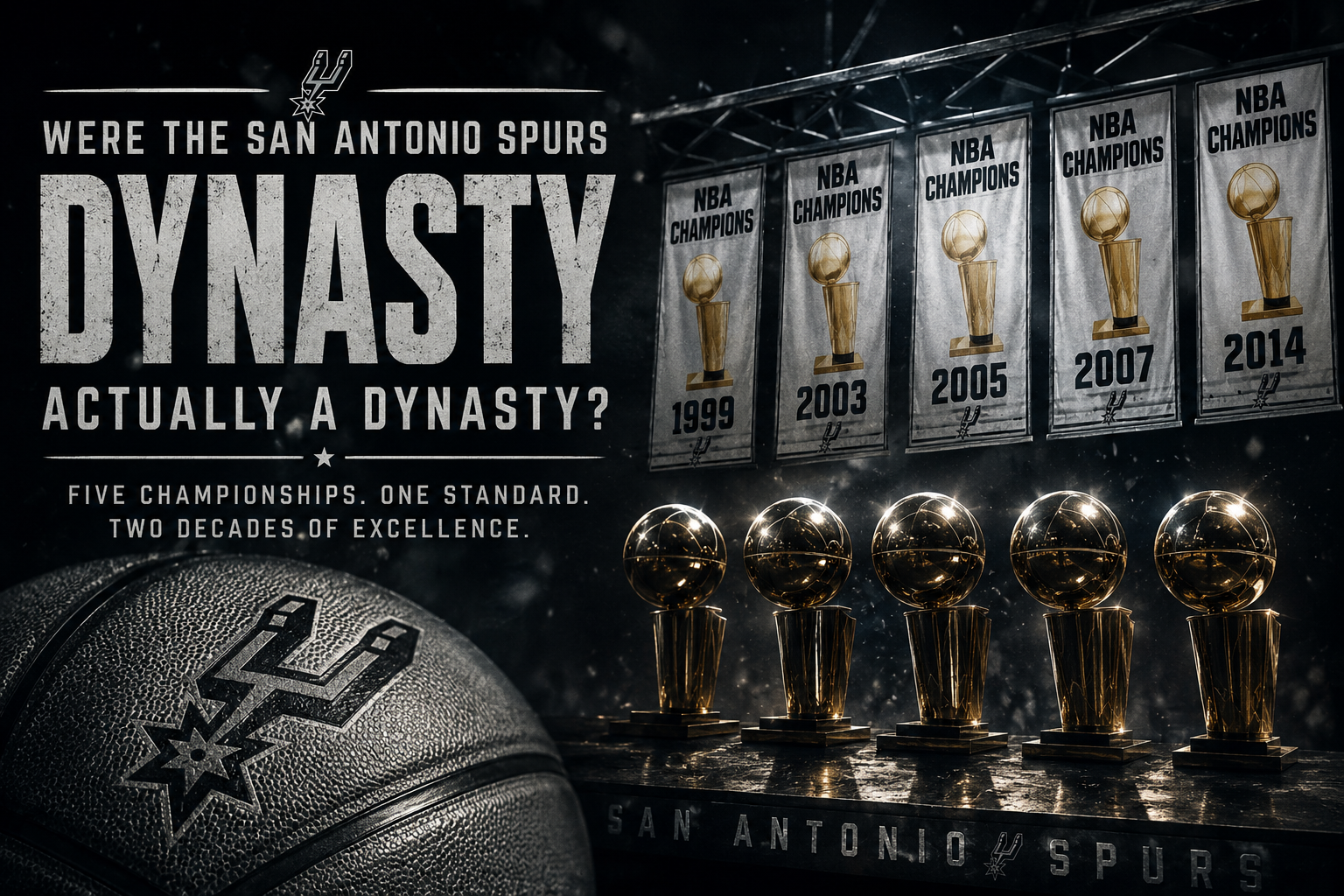
1999. 2003. 2005. 2007. 2014.
Five championships, but never back-to-back. They didn’t even return to the Finals immediately after any of their first four championships. That’s what makes this such an interesting discussion. We don’t usually think of dynasties as teams that win a championship, disappear from the Finals for a few seasons, win another one, disappear again and then somehow win another championship seven years later.
We don’t consider the LeBron James, Dwyane Wade and Chris Bosh Miami Heat a dynasty despite reaching four consecutive NBA Finals and winning two championships. So how can we call San Antonio a dynasty when the Spurs never even successfully defended one of their titles?
For me, the answer is simple: because dominance doesn’t have to look the same every time.
The Spurs were absolutely a dynasty. They were just the weirdest dynasty the NBA has ever seen.
The Consistency Was Ridiculous
What separates San Antonio from almost every other great team wasn’t a short burst of dominance. It was that they simply wouldn’t go away.
After winning their first championship in 1999, the Spurs remained one of basketball’s elite teams for essentially the next two decades. From 1999-00 through 2016-17, San Antonio won at least 50 games every full 82-game season. Even during the lockout-shortened 2011-12 season, they went 50-16.
Look at some of the win totals San Antonio produced during this period: 58, 60, 57, 59, 63, 58, 61 and 62 wins. For most franchises, one 60-win season becomes something fans remember for decades. San Antonio kept casually throwing them onto the pile.
And the championships weren’t coming against weak competition either. The Spurs existed in an absolutely loaded Western Conference. During their run, they had to deal with the Shaq and Kobe Lakers, Dirk Nowitzki’s Mavericks, Steve Nash’s Suns, Kobe’s second championship Lakers teams, Kevin Durant’s Thunder and eventually Stephen Curry’s Warriors.
Yet somehow, year after year, San Antonio remained there.
It Started With the Twin Towers
The first version of the dynasty looked completely different from the last. When San Antonio won its first championship in 1999, the Spurs were built around David Robinson and Tim Duncan. Duncan had only entered the league the previous season, but it became obvious almost immediately that San Antonio had found its next franchise player.
The Spurs went 37-13 during the lockout-shortened regular season and then ripped through the playoffs with a 15-2 postseason record, eventually defeating the New York Knicks in the NBA Finals.
Four years later, Duncan had fully taken control. The 2002-03 Spurs won 60 games and captured another championship, this time defeating the New Jersey Nets. It was also Robinson’s final NBA season, creating an almost perfect transition from one era of Spurs basketball into another.
Instead of collapsing when Robinson retired, San Antonio simply evolved.
Then Came the Big Three
Tony Parker and Manu Ginóbili developed alongside Duncan, creating the core most people associate with the Spurs dynasty. And here’s where San Antonio really became San Antonio.
They weren’t built around celebrity. They weren’t constantly chasing the biggest free agent available. There wasn’t much drama surrounding the team. They drafted well, developed players, played defense, moved the basketball and trusted Popovich’s system. It wasn’t always flashy. It was just brutally effective.
The Spurs won another championship in 2005, beating the defending champion Detroit Pistons in a seven-game Finals. Two years later, they were champions again, sweeping LeBron James and the Cleveland Cavaliers in the 2007 Finals.
At that point, San Antonio had won four championships in nine seasons.
If the story ended there, I would already have a difficult time arguing they weren’t a dynasty.
But somehow, it didn’t end there.
The Dynasty Reinvented Itself
This is what makes the Spurs different from almost every dynasty we’ve ever seen. Most dynasties have one recognizable version. You picture the Showtime Lakers and immediately think Magic Johnson and Kareem Abdul-Jabbar running the floor. You picture the 1990s Bulls and see Michael Jordan and Scottie Pippen. You picture the early-2000s Lakers and see Shaq dominating the paint with Kobe beside him.
The Spurs changed.
The early championship teams were built around Duncan and Robinson controlling the paint. The mid-2000s teams were defensive, physical and methodical. Then as Duncan, Parker and Ginóbili aged, San Antonio transformed again into one of the most beautiful passing offenses basketball has ever seen.
And during that transition, another star emerged: Kawhi Leonard.
The crazy thing is that Kawhi wasn’t simply another role player who happened to join the dynasty. He eventually became one of the best players in basketball. San Antonio had somehow transitioned from Robinson to Duncan, built a championship core around Duncan, Parker and Ginóbili, and then found another future superstar near the end of the run.
That is organizational excellence on a level very few franchises have ever matched.
One Shot Away From Another Championship
San Antonio returned to the NBA Finals in 2013 against LeBron and the Miami Heat. The Spurs were seconds away from winning championship No. 5 in Game 6. They led 95-92 late in the fourth quarter and preparations for the trophy presentation were already beginning.
Then Chris Bosh grabbed an offensive rebound.
Ray Allen backed into the corner.
And you know the rest.
Allen hit one of the most famous shots in NBA history, Miami eventually won Game 6 in overtime and then defeated San Antonio in Game 7.
For many teams, that kind of loss could destroy them. Imagine spending an entire season trying to win a championship, getting within seconds of accomplishing it, and then watching it disappear on one shot.
San Antonio responded by coming back the very next season.
The Perfect Ending
The 2013-14 Spurs won 62 games, finished with the NBA’s best record and returned to the Finals for a rematch against Miami.
This time, it wasn’t close.
San Antonio dismantled the Heat in five games. The ball movement was ridiculous. Everyone touched the basketball. Everyone seemed to make the extra pass. Duncan was still there. Parker was still there. Ginóbili was still there. But now Kawhi had become a major part of the equation, ultimately winning Finals MVP.
Fifteen years after winning their first championship, the Spurs were champions again.
That sentence alone answers the dynasty question for me.
Fifteen years. Five championships. The same franchise cornerstone. The same head coach. Multiple generations of supporting players. Five all-time great players passing through the organization during the overall run.
What other dynasty looked like that?
Gregg Popovich Was the Constant
Players changed. The style changed. The league changed.
Gregg Popovich remained.
Pop won all five championships with San Antonio and eventually became the NBA’s all-time leader in regular-season coaching victories. He also won three Coach of the Year awards.
You can make arguments for Phil Jackson, Red Auerbach and others when discussing the greatest coach ever. But Popovich absolutely belongs in that conversation.
What strengthens his case is that San Antonio didn’t dominate with one formula. Popovich adapted. When Duncan was younger, the offense could run through him in the post. As Parker and Ginóbili developed, they became increasingly important creators. As the league moved toward spacing, shooting and ball movement, San Antonio evolved with it.
The 1999 champions and 2014 champions barely looked like they belonged to the same basketball era.
Yet both were unmistakably Spurs teams.
So, Were the Spurs a Dynasty?
Absolutely.
They just weren’t a conventional one.
If your definition of a dynasty requires consecutive championships, San Antonio won’t qualify. They never went back-to-back. They never three-peated. They never had the overwhelming short-term dominance of Jordan’s Bulls or the Shaq-Kobe Lakers.
But I think that definition is too narrow.
The Spurs won championships in 1999, 2003, 2005, 2007 and 2014. They reached another Finals in 2013 and came within seconds of potentially winning a sixth championship. They maintained an almost absurd level of regular-season excellence while surviving multiple generations of Western Conference contenders.
Most importantly, there was a clear thread connecting everything: Tim Duncan and Gregg Popovich.
Duncan arrived in 1997. Two years later, San Antonio was champion. By the time he retired in 2016, he had five championships, two MVPs, three Finals MVPs and 15 All-Star selections.
That’s not a great team having a few good years.
That’s an era.
Maybe the Spurs weren’t the most dominant dynasty. Maybe they weren’t the flashiest dynasty. They certainly weren’t the dynasty that received the most attention. But from David Robinson and a young Tim Duncan in 1999, through Parker and Ginóbili, all the way to Kawhi Leonard lifting Finals MVP in 2014, San Antonio found ways to keep winning while almost everything around them changed.
They never defended a championship.
They never needed to.
The San Antonio Spurs were absolutely a dynasty — they just did it their own way.
And now, more than a decade after that fifth championship, San Antonio may have found the player capable of starting the entire process again: Victor Wembanyama.
The first Spurs dynasty had Robinson, Duncan, Parker, Ginóbili and eventually Kawhi. Now the franchise has another generational talent to build around, and we’ve already seen what this organization can accomplish when it gets one.
So perhaps the more interesting question isn’t whether the old Spurs were a dynasty.
They were.
The question is:
Will Victor Wembanyama be able to create the next Spurs dynasty?
If you enjoyed this article, leave a like and subscribe to Ethical Sports Takes for more NBA debates, rankings, predictions and opinions.
Leave a Reply