Every NFL season brings a new group of rookies ready to make their mark on the league, and the 2026 Offensive Rookie of the Year race has several legitimate candidates. Jeremiyah Love enters the season as one of the biggest names to watch, Fernando Mendoza was the No. 1 overall pick, and several other rookies should receive opportunities to make an immediate impact.
But my pick isn’t Love or Mendoza.
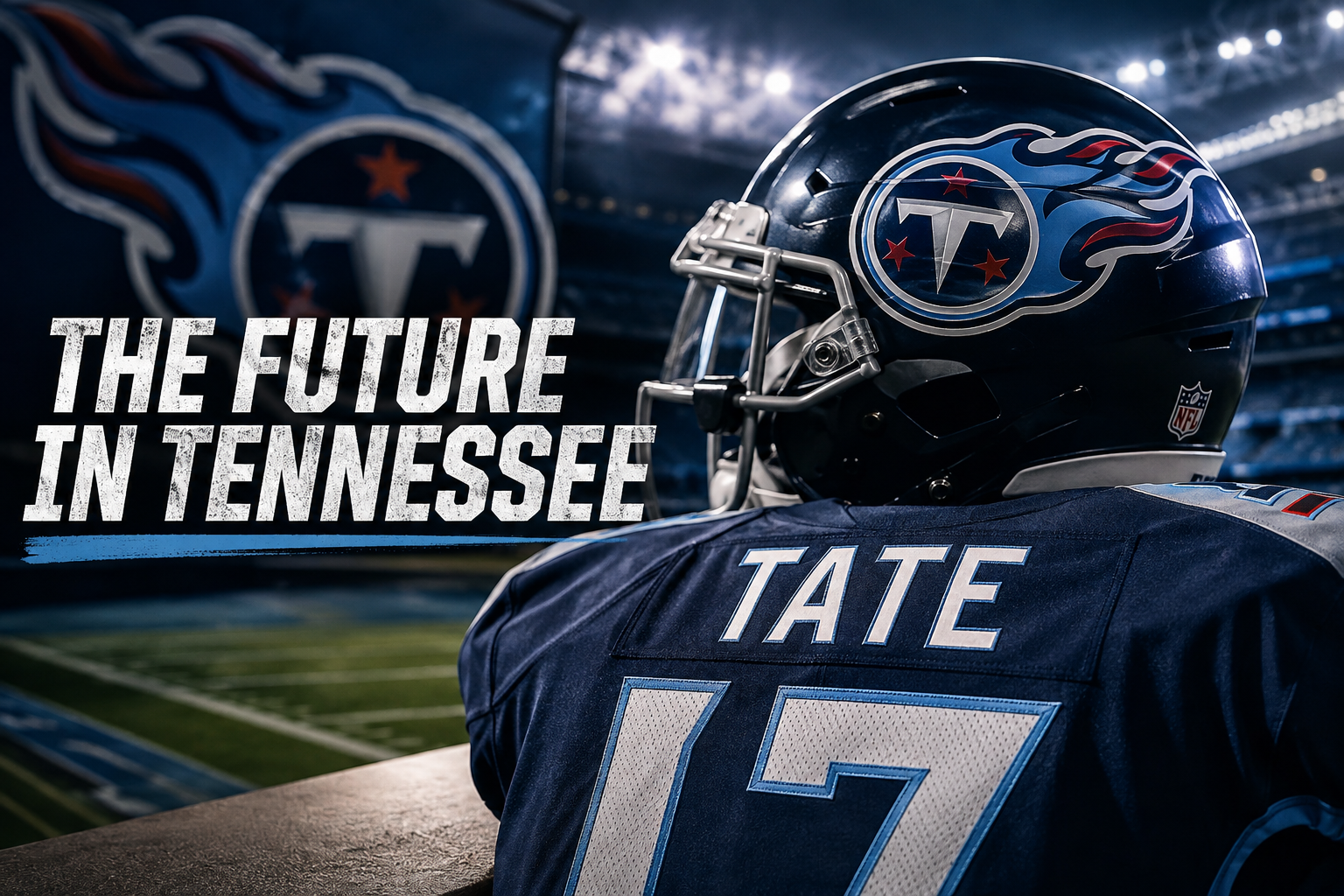
I’m taking Tennessee Titans wide receiver Carnell Tate to win the 2026 NFL Offensive Rookie of the Year.
Tennessee selected Tate fourth overall in the 2026 NFL Draft, and you don’t use that kind of draft capital on a wide receiver unless you intend to make him a major part of your offense immediately. At roughly 6-foot-2 and 192 pounds, Tate gives second-year quarterback Cam Ward a big target with the route-running ability, catch radius and body control to develop into a legitimate No. 1 NFL receiver.
More importantly, I think Tate is entering almost the perfect situation for a rookie receiver to produce immediately.
The Production Was Already There at Ohio State
Tate comes from an Ohio State program that has become a factory for NFL wide receivers, and his college production shows why Tennessee was comfortable selecting him fourth overall.
Across three seasons with the Buckeyes, Tate recorded 121 receptions for 1,872 yards and 14 touchdowns in 39 games. His development was clear throughout his college career, culminating in a huge junior season in 2025 despite missing three games because of injury.
Tate finished that season with 51 catches for 875 yards and nine touchdowns, averaging an impressive 17.2 yards per reception. He recorded four 100-yard games and earned first-team All-Big Ten honors, along with second-team All-American recognition from multiple organizations.
Those numbers are impressive, but what excites me most is how Tate’s skill set translates to the NFL. He doesn’t need 12 catches every game to make an impact. His ability to create plays downfield means a handful of targets can quickly turn into 80 or 100 receiving yards.
Put that kind of receiver next to a young quarterback with Cam Ward’s arm talent, and I think Tennessee could have something special.
Why Cam Ward’s Second-Year Leap Matters
My prediction for Tate is also partly a prediction about Cam Ward.
Quarterback development is rarely linear. We’ve watched plenty of young quarterbacks take significant leaps once they’ve had a full NFL season to adjust to the speed of the game, learn how defenses attack them and become more comfortable running an NFL offense.
We’ve seen young quarterbacks such as Josh Allen and Drake Maye make major jumps as they developed, while Patrick Mahomes exploded after spending his rookie season learning behind Alex Smith. Every quarterback develops differently, but the point remains the same: sometimes the biggest improvement comes once a young quarterback has had time to understand the NFL.
I expect Ward to take his own second-year leap in 2026.
That matters enormously for Tate. Instead of entering the NFL with complete uncertainty at quarterback, Tate is joining a team that already has a young QB Tennessee believes can become its franchise player. The Titans now have an opportunity to let Ward and Tate develop together, and I think that relationship could eventually become the foundation of their offense.
That’s how I believe you properly develop a young quarterback. Give him a talented young receiver, put them in a system that believes in both players and allow them to build chemistry together.
If Ward improves the way I expect him to, Tate should be one of the biggest beneficiaries.
The Opportunity Could Be Massive
This is probably the biggest reason I’m picking Tate.
Targets matter.
A rookie receiver can have all the talent in the world, but if he’s the third or fourth option in an established offense, there are only so many opportunities available. I don’t think Tate is going to have that problem in Tennessee.
Calvin Ridley remains an established veteran receiving option, but I actually think that’s good for Tate rather than bad. Tate doesn’t have to walk into the building and immediately carry the entire receiving room by himself. Ridley can take defensive attention away from the rookie while also providing veteran leadership on a relatively young Titans team.
Tennessee also didn’t spend the No. 4 overall pick on Tate for him to disappear into the depth chart.
I fully expect him to become one of Ward’s primary targets immediately, and if their chemistry develops quickly, Tate could see substantial volume throughout his rookie season. With his ability to make plays downfield, he doesn’t necessarily need an outrageous number of targets to produce big numbers either.
That combination is exactly what I’m looking for in an Offensive Rookie of the Year candidate: talent, opportunity, quarterback upside and major organizational investment.
The Calvin Ridley Factor
I also think Calvin Ridley’s presence is being overlooked when discussing Tate.
Ridley has been in the NFL long enough to understand what it takes to succeed as a professional receiver. Tate is only 21 years old and is entering a completely different environment from Ohio State. Having an experienced receiver in the same room gives him someone who understands NFL preparation, route details, film study and the weekly demands of playing the position.
Eventually, Tennessee will want Tate to become one of the leaders of this offense himself. Having Ridley around could help him get there.
There’s also the football side of it. Defenses can’t simply behave as though Tate is Tennessee’s only receiving threat. If Ridley continues commanding respect from opposing secondaries, Tate should receive opportunities to attack favorable matchups.
For a young receiver trying to establish himself, that’s not a bad situation at all.
What About Jeremiyah Love and Fernando Mendoza?
There are other rookies I believe have the talent to win this award.
Jeremiyah Love is probably Tate’s biggest competition, but I’m not sold on his situation in Arizona. Love was the No. 3 overall pick for a reason and has the talent to produce immediately, but I see the Cardinals struggling this season. It’s difficult for a rookie to put together an award-winning offensive campaign when the offense around him isn’t consistently producing.
Love could absolutely prove me wrong. I think he’s extremely talented. I simply prefer Tate’s situation and his potential volume in Tennessee.
Then there’s Fernando Mendoza, the No. 1 overall pick.
Mendoza obviously has the advantage of playing quarterback, and quarterbacks will always command attention in an award race if they’re producing. But I actually don’t expect Mendoza to play much this season unless injury or poor play forces the Raiders’ hand.
Las Vegas has Kirk Cousins entering the season ahead of him, and I think allowing Mendoza to sit and learn could ultimately be better for his career than throwing him onto the field immediately. Mendoza has already demonstrated tremendous talent, throwing for 3,535 yards and 41 touchdowns during Indiana’s undefeated national championship season, but there’s nothing wrong with giving a young quarterback time to develop.
Let him learn how to prepare like an NFL quarterback, study behind an experienced veteran and become comfortable with the Raiders’ offense before asking him to become the face of the franchise.
If Mendoza spends most of his rookie year learning, however, he obviously won’t accumulate the production necessary to win Offensive Rookie of the Year.
That’s another reason I keep coming back to Carnell Tate. I don’t have the same questions about whether he’ll get on the field or whether Tennessee will give him opportunities. I expect Tate to play immediately, receive plenty of targets and grow alongside Cam Ward from Week 1.
When I’m predicting a rookie award, opportunity matters almost as much as talent, and Tate should have both.
What Would an OROY Season Look Like?
Tate doesn’t need to immediately become one of the five best receivers in football to win this award.
A rookie season somewhere around 1,000 receiving yards with seven to ten touchdowns would put him firmly in the conversation, especially if Ward takes the second-year leap I’m expecting and Tennessee’s offense improves along with him.
Tate’s college production gives me confidence that he can create enough explosive plays to reach those numbers. He averaged 17.2 yards per reception during his final season at Ohio State, meaning his game isn’t dependent entirely on catching eight or nine short passes every Sunday.
If Ward trusts him downfield and Tate becomes one of Tennessee’s primary red-zone targets, the production can add up very quickly.
And that’s ultimately what these awards come down to.
Production and opportunity.
If you enjoyed this article, make sure to like the post and subscribe to Ethical Sports Takes for more NFL, NBA and Formula 1 content. As always, thanks for reading and supporting Ethical Sports Takes.
Leave a Reply